

Common name: Sugarcane
Other common names: Noble Cane
Description
Sugarcane is a tall grass that originated in the Old World tropics, most likely in the highland areas of Papua New Guinea, and it is the primary source of the world's sugar, made from the sweet juice, or sap, in its stems. Its use, however, extends far beyond sugar production, with various parts of the plant used as raw material in a range of industries, including energy, chemicals, natural fibres and livestock feed.
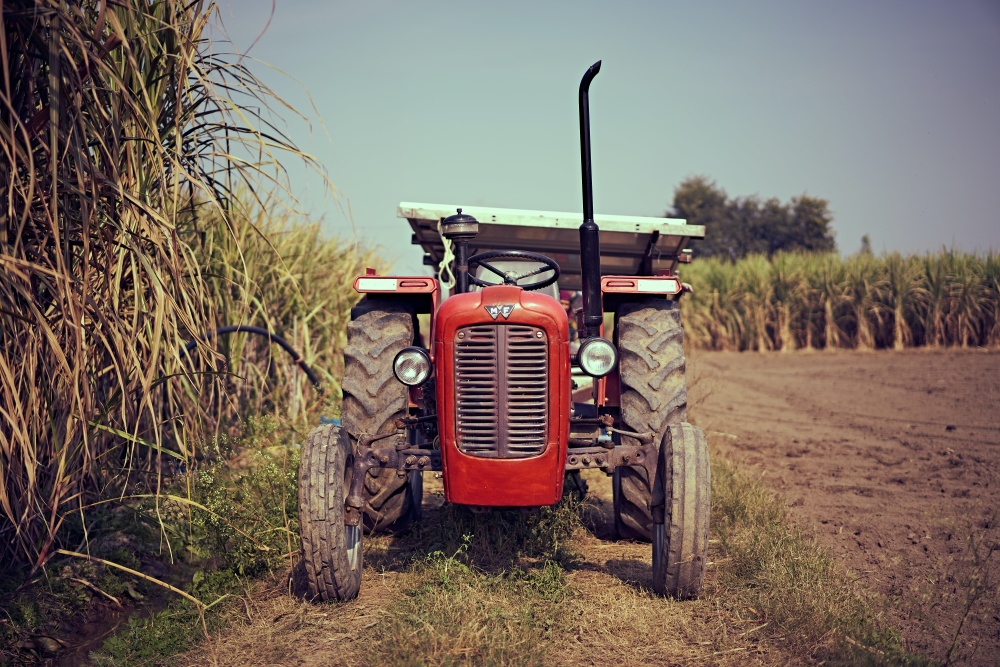
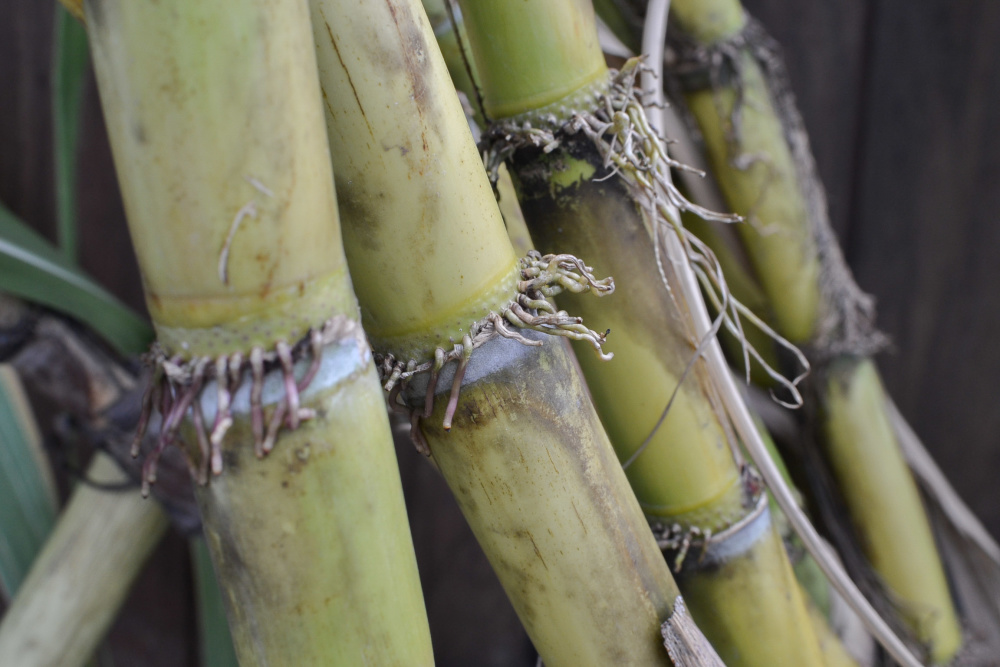
Closely related to bamboo and other grasses, sugarcane has erect stems typically 3 to 5 m (10 to 16 ft) tall and 3 to 7 cm (1.2 to 2.7 in) in diameter, made of jointed sections 20 to 40 cm (0.6 to 1.3 ft) long. These grow in clumps sprouting from underground rhizomes.
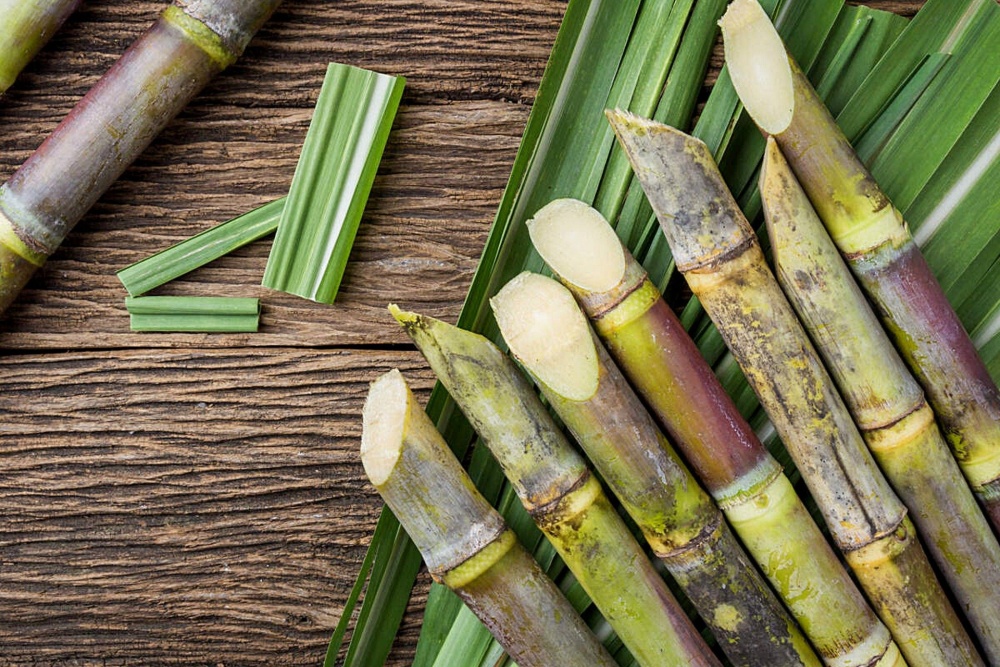
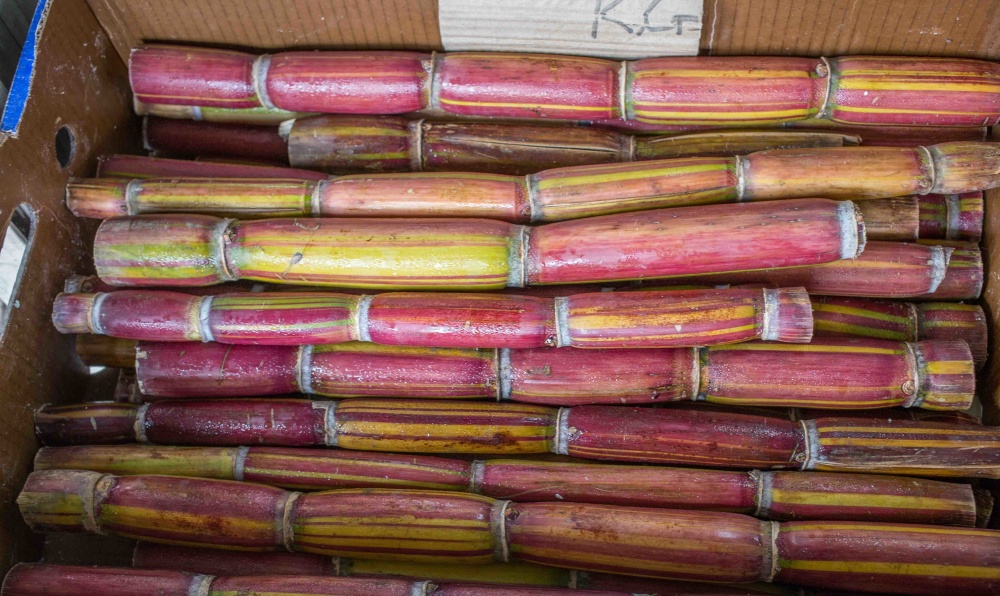
Between the joints is a smooth, hard exterior that protects a semi-soft, fibrous and juicy core. Known as the rind or peel, it has a waxy coating and can range in colour from lime green through yellow or purple to nearly black, or be variegated, depending on the variety. Stem diameter, rind thickness, juice volume, and juice sweetness also vary by variety.
The leaves are long, medium-green and sword-shaped, with sharp, serrated edges that slice into fingers. These sprout from new growth at the tops of the stems and have an upright habit that adds to the plant's height, ultimately making up almost one-third of the plant's total height.
Flowering occurs when the plant reaches maturity and is encouraged by short days, or rather, long nights. Tall flower spikes arise at the top of the plant and hold aloft a large, triangular-shaped flower head, which is known as the arrow because of its shape. Although sugarcane flowers profusely, the flowers rarely set seed.
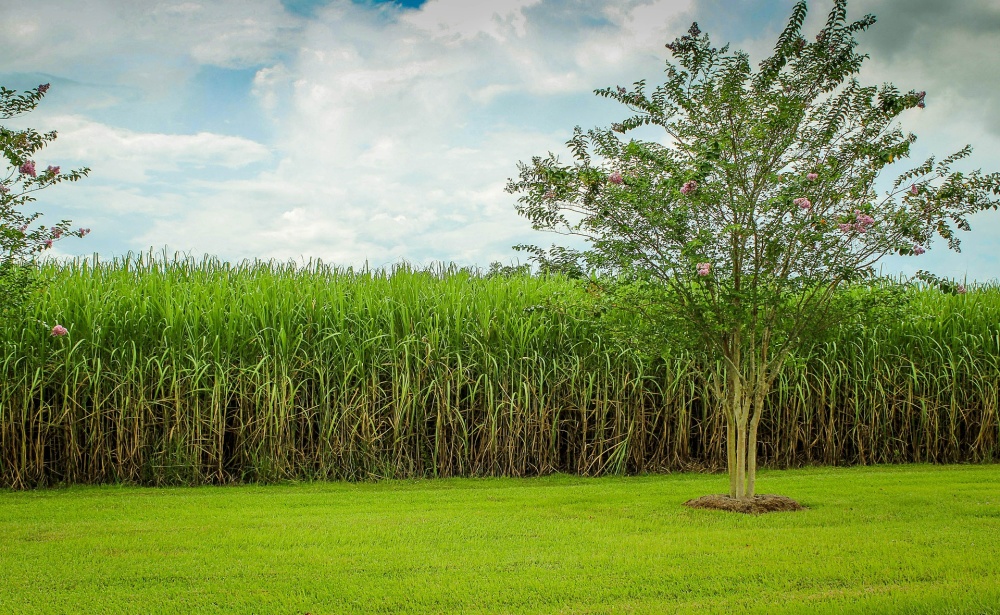
Photo by JamesDeMers from Pixabay
Edible uses
By use, sugarcane falls into two main types: chewing canes and crystal canes, the latter used in sugar production. Chewing cane, as the name suggests, is the original use for sugarcane, with cultivation dating back hundreds of years. Although still cultivated today, it is grown mostly in home gardens for personal use.
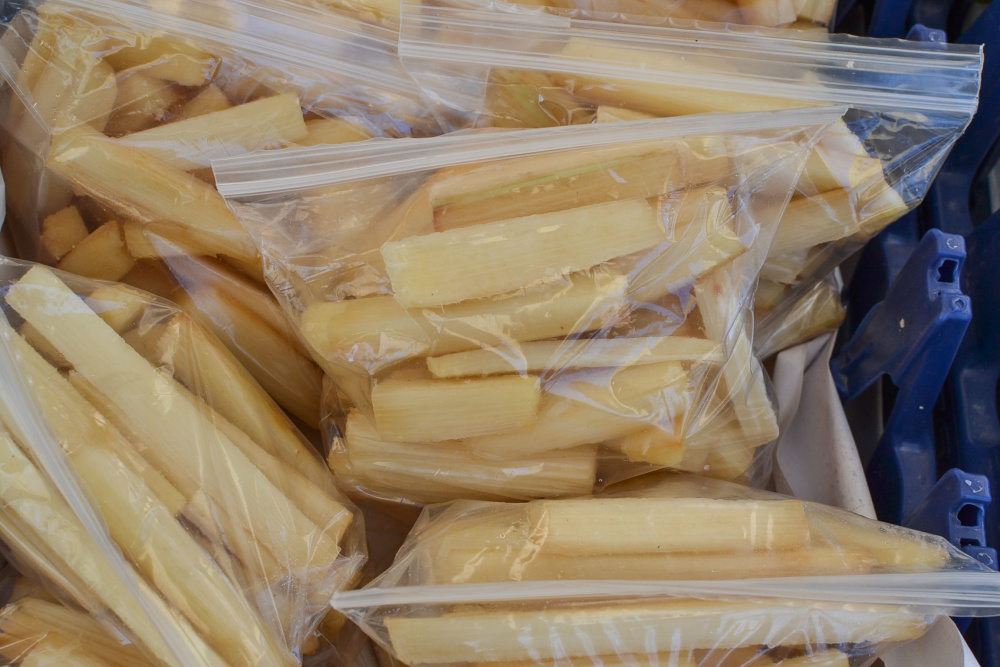
Chewing canes are thick-stemmed canes with a relatively soft core and high levels of juice and sugar. The mature stems are usually cut into manageable lengths, the rind peeled, sometimes with the teeth, and the soft, fibrous core chewed and sucked to extract the juice, then spat out. Sometimes people cut the peeled lengths into bite-sized pieces, bag them, and sell them at the market or on the roadside. Chewing canes are also cut into swizzle sticks to dress up fancy drinks and tropical cocktails served at bars and holiday resorts.
Crystal canes, or canes used in sugar production, tend to be slimmer-stemmed canes and have juice with a higher sucrose content, causing it to crystallise readily.
Natural sweetener - Sugar is made by cutting the stems into shorter lengths and pressing them to extract the juice. The extracted juice is then filtered and boiled to evaporate water, leaving a syrup that, when crystallised, yields raw sugar. However, raw sugar contains molasses, a thick, dark, almost black syrup that, despite its high sugar content, cannot be crystallised, so it must be removed, leaving refined white sugar. Refined brown sugar is made by adding some molasses back to white sugar. Castor sugar and icing (or powdered) sugar are finely ground white sugar.
Refined sugar is the world's most widely available and consumed sweetener, and is incorporated in many foods and drinks, making it a globally important energy food.
In traditional sugar production, the molasses is not removed, and the crystallisation and refining processes are skipped, resulting in a dark brown, semi-moist but highly nutritious sugar. Known as 'Jaggery' or 'Gur' in India and 'Panela' in Latin America, it is usually moulded into shapes for easy transport, sale and storage. However, its relatively high moisture content results in a shorter shelf life than refined sugar.
A small proportion of molasses, particularly of the lighter grades, is reserved for human consumption. Traditionally sold in jugs and jars, it has long been used in baking to make sweet buns and Christmas puddings. It is also used in confectionery and barbecue sauces, and it gives Boston Baked Beans their characteristic sweetness and syrupy texture.
Natural food preservative - In jams, jellies, fruit conserves, canned fruit and confectionery, sugar is used as both a sweetener and preservative.
Alcoholic drink - Ethanol produced from sugarcane was initially intended only for making rum to drink. It takes 2 to 3 litres (0.5 to 0.8 gallons) of molasses to make 1 litre (0.3 gallons) of rum. When freshly distilled, rum is a colourless liquid at around 50 per cent overproof, meaning it takes 100 litres to produce 150 litres of regular rum after diluting with water. Dark rum gets its caramel colour from the oak barrels in which it is aged, which, on average, is five years but can be up to twenty years or more for some premium-aged rums. Ethanol from molasses is also used to make gin and vodka.
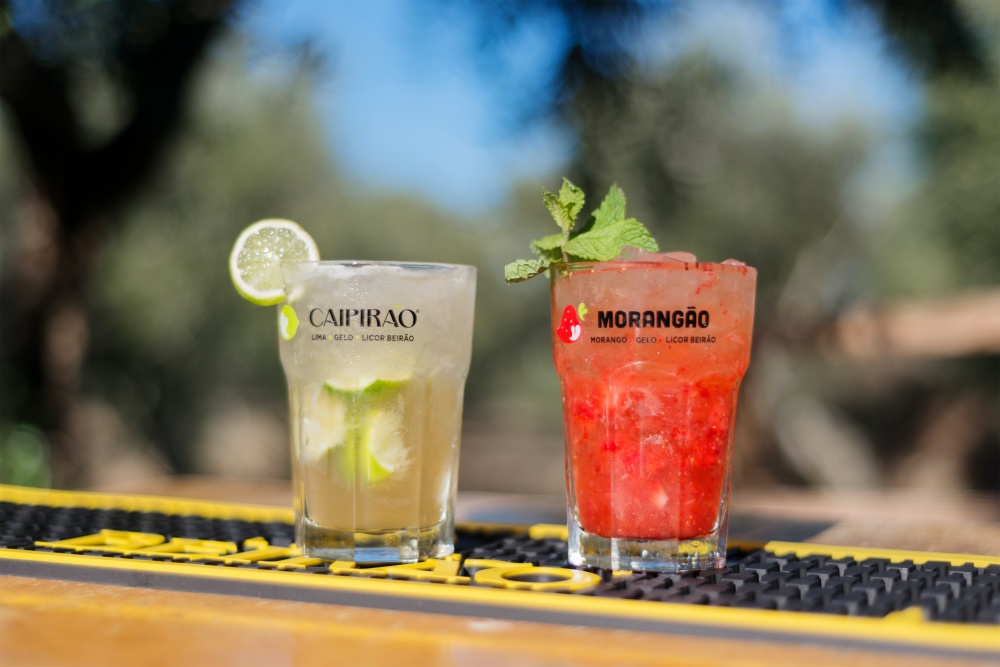
Sometimes cane juice is not processed into sugar but is fermented and distilled directly, as with Cachaça, a distilled spirit from Brazil. Cachaça is best known for its role in the Caipirinha, a Brazilian cocktail made by blending shots of Cachaça with lime slices, sugar, and crushed ice. A similar spirit, known as Rhum Agricole, comes from the Caribbean island of Martinique.
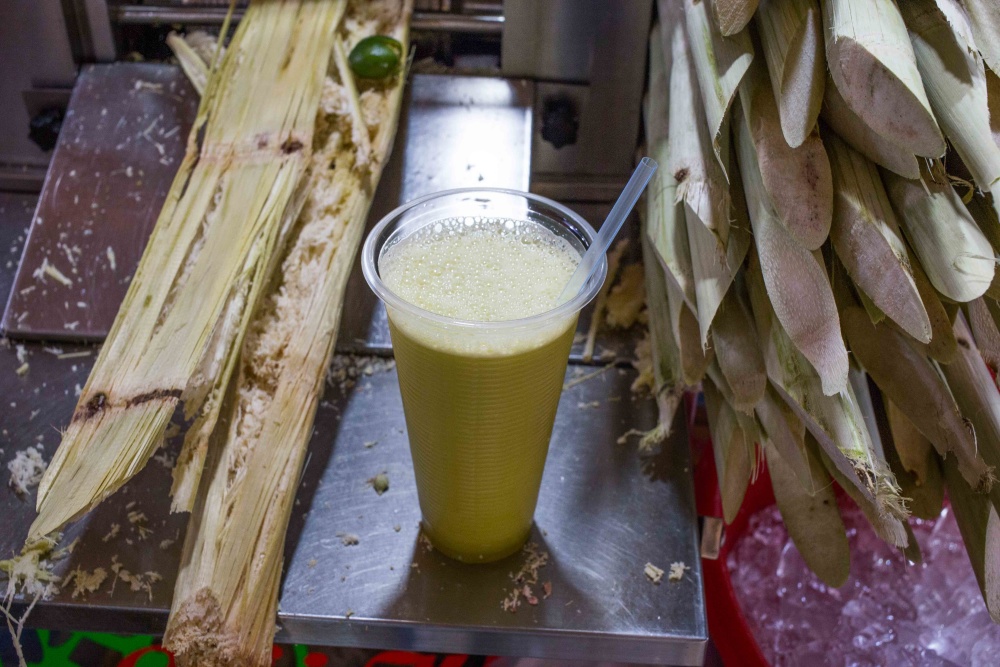
Non-alcoholic drink - Sugarcane juice is also commonly enjoyed without alcohol, usually chilled, with a squeeze of lime to balance its sweetness.
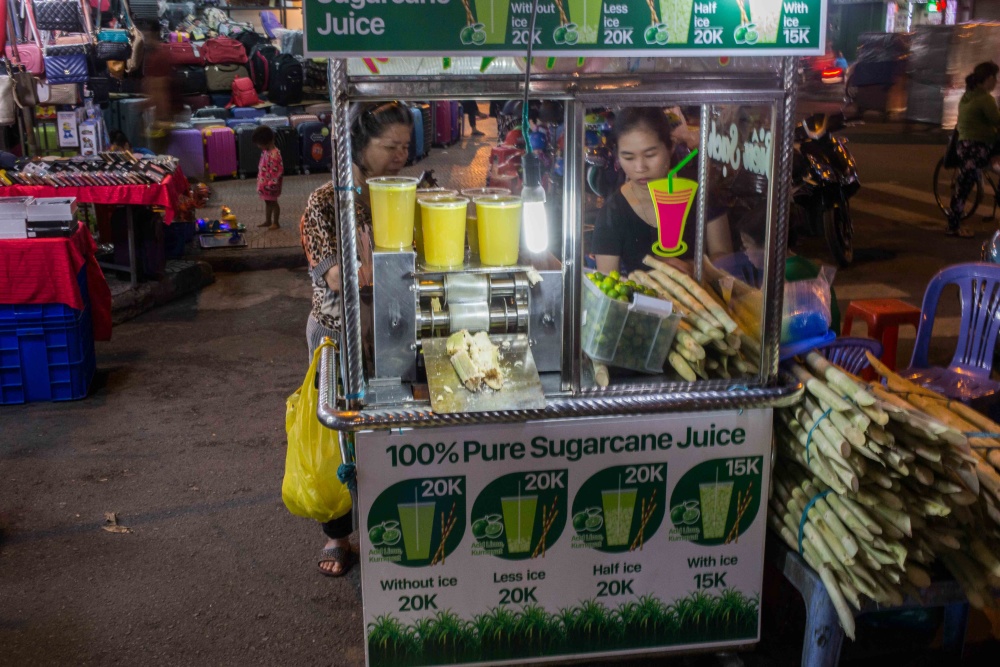
Sugarcane juice vendor (Vietnam)
Material uses
Plant-based alcohol - Most molasses is converted into ethyl alcohol, otherwise known as ethanol. It is fermented with yeast and water to produce a solution known as the 'Wash' that contains up to 9% alcohol. The wash is then distilled to extract the alcohol, traditionally in pot stills, but more recently in sophisticated continuous column stills.
Other uses soon followed the rum trade, including use as a solvent and carrier in perfumes and colognes, such as in Bay Rum, made by mixing rum with bay oil from the leaves of the Bay Rum Tree (Pimenta racemosa). Ethanol has become widely used as an industrial solvent because it dissolves organic materials such as gums, resins, and essential oils.
Biofuel - More recently, ethanol has been used as a fuel for internal combustion engines and is produced on a massive scale in Brazil and the United States for this purpose.
After extracting the juice from the stems, a large amount of fibrous material remains, known as bagasse, which is usually burnt in giant boilers at the sugar factory to produce heat, steam, and electricity to power the factory, with any excess exported to the grid.
Bio-based plastic - Ethanol has also emerged as a petroleum substitute in plastic production.
Livestock feed- Molasses is also an important livestock feed, particularly during the dry season when there is little else for ruminant livestock to eat. It is usually mixed with chopped cane tops and leaves, or poured over silage, hay, or grains fed to cows, sheep, and goats. It is also added to pig and chicken rations. In addition to being a good carbohydrate source, molasses is highly palatable, increasing livestock acceptance of other feeds mixed with it.
Rust removal - A less conventional use of molasses is rust removal. Powerful chelating agents in molasses, mainly cyclic hydroxamic acids, bind to rust, making it soluble and allowing it to be washed off with water. However, rust-covered items must be fully immersed in molasses for at least 3 months for the treatment to be effective.
Natural packaging - If not burnt as fuel, bagasse can be compressed and moulded into biodegradable food-service or packaging products, such as disposable plates, cups and take-away food containers.
Manufactured wood - Bagasse can also be moulded into fibreboard for wallboards, panelling and acoustic tiles.
Mulch - Bagasse is also commonly baled and sold as a mulch under the name 'Sugar Cane Mulch'. Inexpensive, lightweight, and easy to handle, sugarcane mulch works like other mulches to conserve soil moisture, reduce soil erosion, and suppress weeds. And because it breaks down quickly, it improves the soil, making it ideal for vegetable gardens.
Plant fibre pulp - Although bagasse is generally a poor fibre for paper pulp production due to damage sustained during juice extraction, it is sufficient for making newsprint and wrapping paper.
Natural wax - A hard, tan-coloured wax similar to carnauba wax from the Wax Palm (Copernicia prunifera) is sometimes recovered from the residue and formulated into waxes for floors, furniture, leather, and waxed paper. A ton of sugarcane yields from 1 to 1.4 kilograms (2 to 3 lbs) of wax.
Health uses
The molasses by-product of refined sugar production is arguably the most nutritious component of sugarcane juice, containing reasonable amounts of the following:
Potassium
Calcium
Magnesium
Selenium
Iron
Vitamin B6
Calcium and iron, in particular, help support healthy bones and tissues. Refined sugar, by contrast, is almost pure sucrose, with a high energy value but little or no nutritional value.
Climate
Sugarcane grows naturally in humid subtropical and tropical climates, generally areas with annual lows of 12 to 25°C, annual highs of 22 to 36°C, annual rainfall of 1200 to 5000 mm and a dry season of 4 months or less.
Sugarcane is also cultivated with irrigation in much drier areas, such as in El Centro, California and the Nile Delta in Egypt. These areas receive less than 100 mm of rainfall annually and are classified as arid or dry year-round.
General interest
For almost a thousand years, people cultivated sugarcane along the Mediterranean coast. Cultivation mostly ceased after colonial powers established sugar plantations in the Caribbean and other parts of the Americas. Today, the ruins of sugarcane mills still stand in Motril, Spain; Syracuse, Sicily; Palestine; and the deserts of southern Morocco, reminding us of that era. Although sugarcane continued to be cultivated in Valencia, Spain, in the eighteenth century, it was not converted into sugar but chewed as a refreshment.
Growing
New plants are usually started from cuttings, called 'setts' or 'billets', comprising one to three jointed sections taken from mature canes.
These are planted horizontally or at a 45° angle in the soil, leaving one end about 5 cm (2 in) above the soil. Good practice is to grow the crop on soil mounds or ridges so the roots have enough room to grow down and drainage is adequate. The conventional method of planting in furrows increases the risk of waterlogging and subsequent rot.
Farmers prepare the soil and plant near the end of the rainy season, when soil moisture is sufficient for good growth and development.
Performs best on deep, rich, friable, free-draining clay-loam, loam, and sandy-loam soils of a moderately acid to slightly alkaline nature, generally with a pH of 6.0 to 7.7, and on sites with full sun exposure.
Problem features
The leaves have sharp edges that can cause injury. Fine hairs on the leaf-sheath can also irritate the skin.
Where it grows
References
Books
-
Adams, C. D. 1972, Flowering plants of Jamaica, University of the West Indies, Mona, Greater Kingston
-
Bladholm, L. 1999, The Asian grocery store demystified, 1st edition, Renaissance Books, Los Angeles, California
-
Brady, G. S. & Clauser, H. R & Vaccari, J. A. 2002, Materials handbook : an encyclopedia for managers, technical professionals, purchasing and production managers, technicians and supervisors, 15th ed., McGraw-Hill, New York
-
Crane, E., Walker, P. & Day, R. 1984, Directory of important world honey sources, International Bee Research Association, London, United Kingdom
-
Gohl, B. 1981, Tropical Feeds : feed information summaries and nutritive values (Revised edition), Food and Agriculture Organization of the United Nations (FAO), Rome
-
Macmillan, H. F. 1943, Tropical planting and gardening : with special reference to Ceylon, 5th ed, Macmillan Publishing, London
-
McIlroy, R.J. 1963, An introduction to tropical cash crops, Ibadan University Press, Ibadan, Nigeria
-
Mors, W. B & Rizzini, C. T. 1966, Useful plants of Brazil, Holden-Day Publishing, San Francisco, California
-
Parkinson, R. 1999, Culinaria : The Caribbean a culinary discovery, 1st. ed, Koìln: koìnemann, Germany
-
Purseglove, J. W. 1981, Tropical crops: Monocotyledons, Longman, Harlow, London
-
Randall, R. P. 2002, A global compendium of weeds, R.G. and F.J. Richardson Press, Melbourne
-
Randall, R. P. 2007, The introduced flora of Australia and its weed status, Cooperative Research Centre for Australian Weed Management, Glen Osmond, South Australia
-
Stewart, A. 2013, The drunken botanist : the plants that create the world's great drinks, 1st ed., Algonquin Books, Chapel Hill, North Carolina
-
Wood, I. M. 1997, Fibre crops : new opportunities for Australian agriculture, Queensland Department of Primary Industries (QLD DPI), Brisbane
Articles, Journals, Reports and Working Papers
-
Morton, J. F. 1976, Pestiferous spread of many ornamental and fruit species in south Florida. In Proceedings of the Florida State Horticultural Society (Vol. 89, pp. 348-353).
-
Morton, J.F. 1964, Honeybee Plants of South Florida, Proceedings of the Florida State Horticultural Society, Vol 77:415-436.