

Common name: Castorbean
Other common names: Castor Oil, Oil Nut
Description
Castorbean is a shrub or small tree originating in tropical Africa and now widely distributed and cultivated for the oil in its seed, which has a range of industrial uses.
It is fast-growing, herbaceous when young, and, with age, develops woody stems, forming either a shrub or a small tree depending on the variety. Some trees reach up to 12 m (40 ft) tall, though 3-5 m (10-16 ft) is more common. In tree form, the trunk is slender with smooth grey-white or light-brown bark and supports a rounded crown with a moderate number of large leaves.
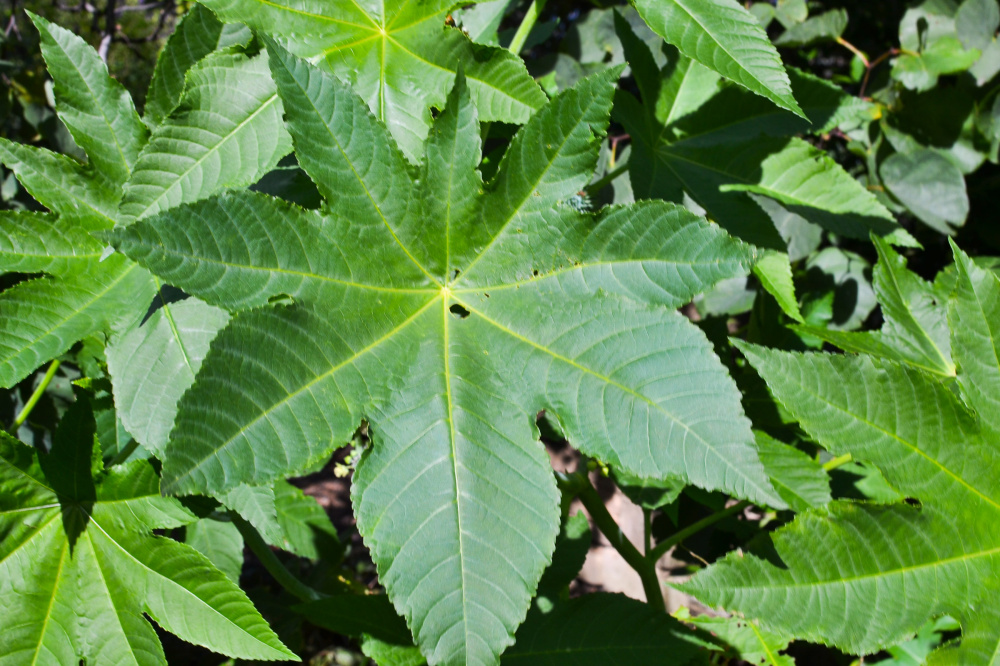
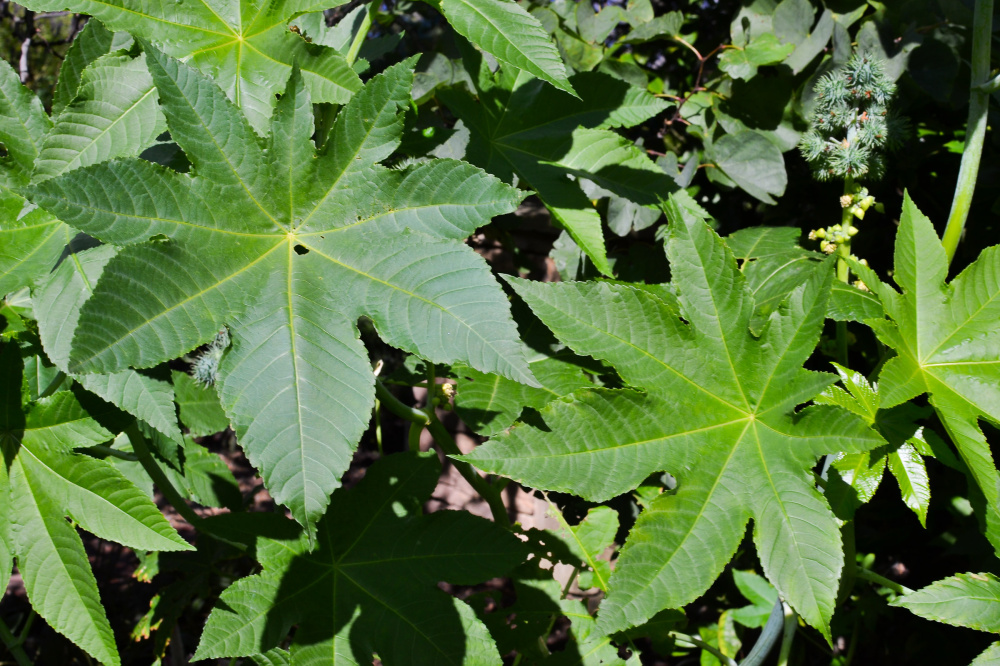
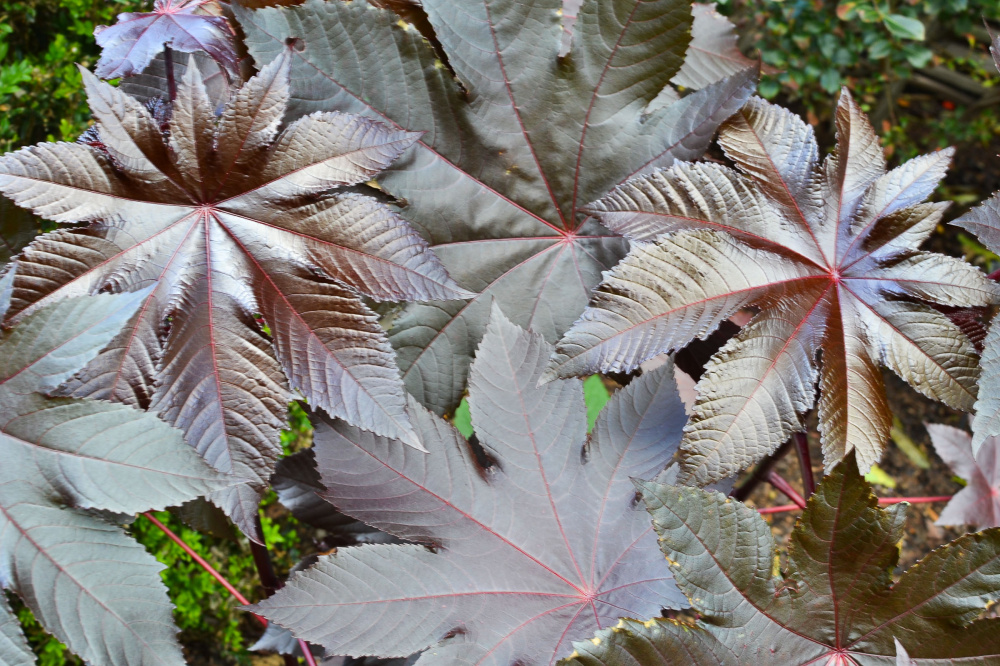
The leaves are large, from 30 to 60 cm (1 to 2 ft) wide and star-shaped with seven to nine serrate, pointed lobes. They emerge bronze, gradually turn green or wine-red in some varieties, and attach to the branches with a long, hollow leaf stalk.
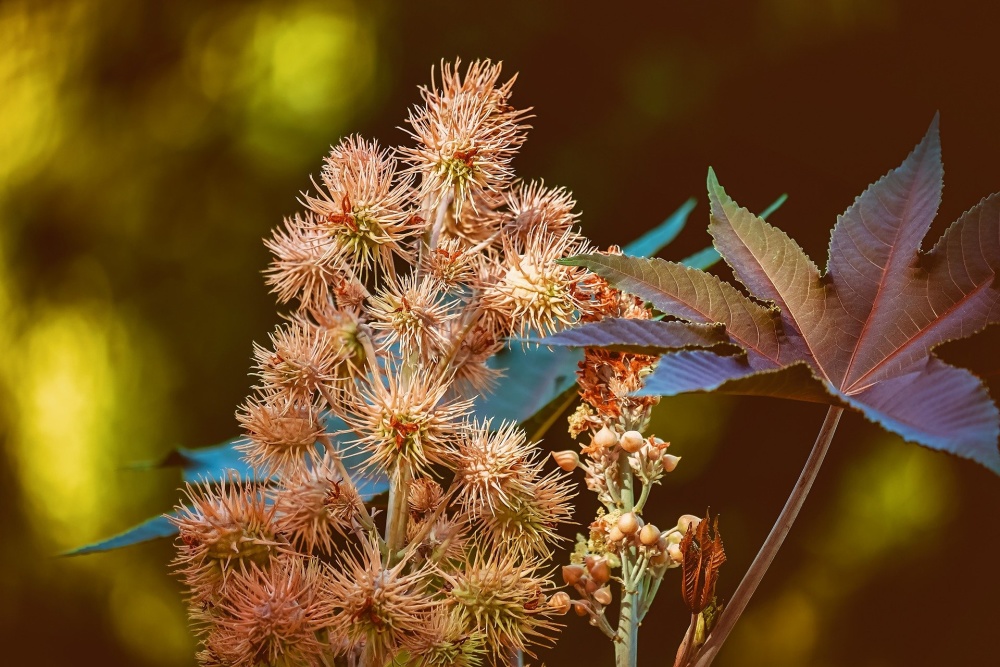
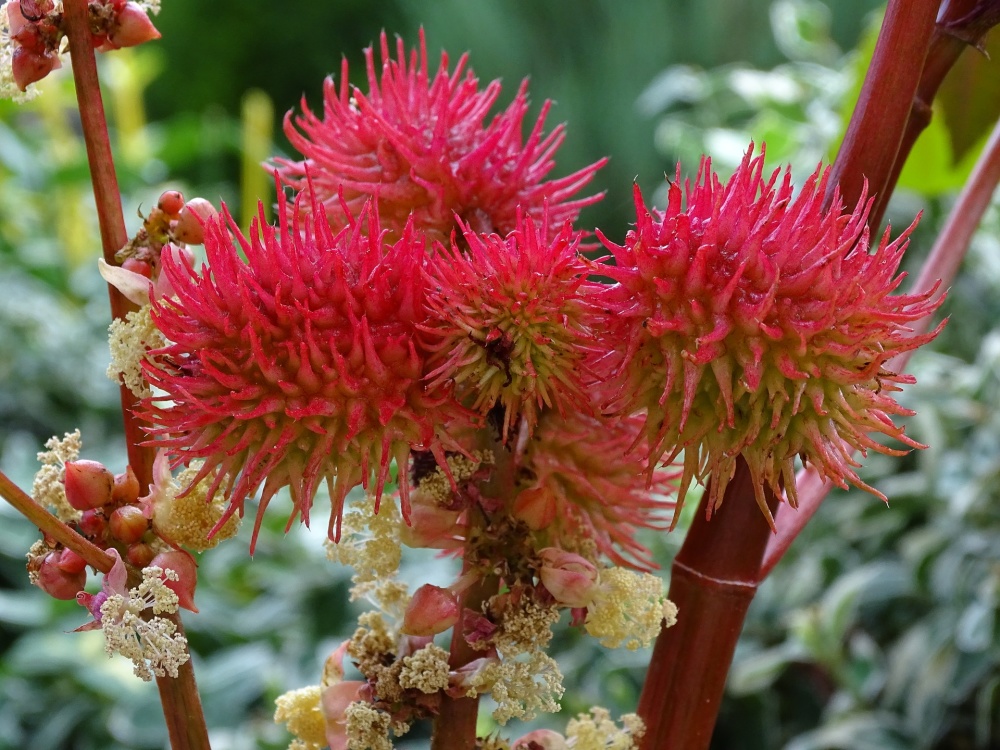
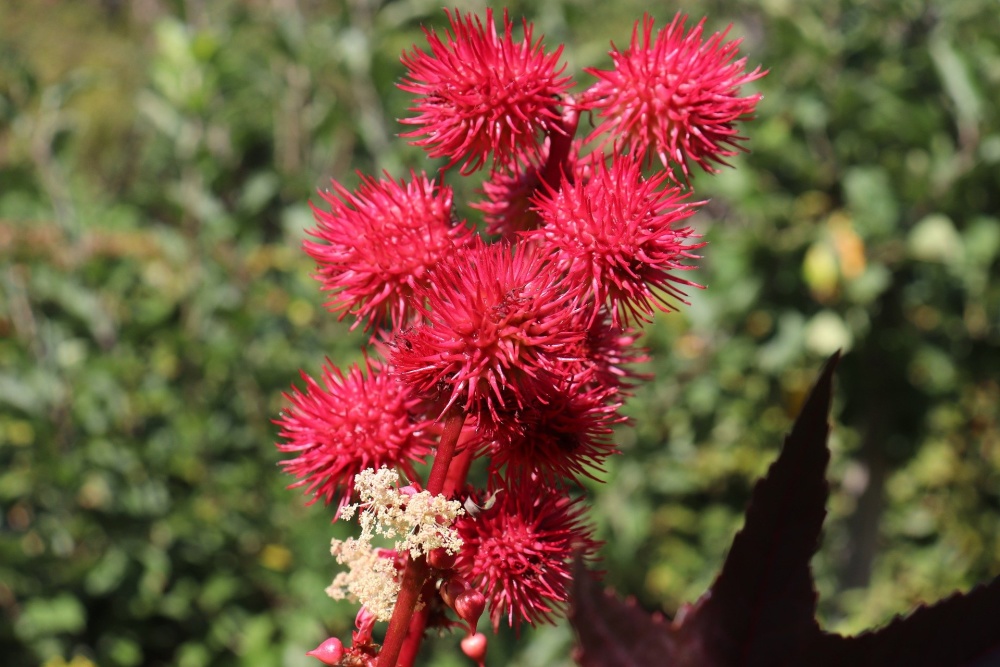
Flowers are unisexual, small, greenish-white and borne in conical flower spikes 15 to 60 cm (0.5 to 2 ft) long, with the male flowers situated below the female ones. They bloom on and off throughout the year but are at their fullest from spring to summer. Fertilised female flowers are followed by burr-like seed capsules, blue-green or red when young, turning brown when mature, with three brown- or black-mottled seeds inside. When fully ripe, the seed capsule bursts open, scattering the seed.
Castorbean comes in a wide variety of varieties, differing in plant size, foliage colour, seed capsule size, and seed size, shape, and colour.
.5905.jpg)
Seedpods
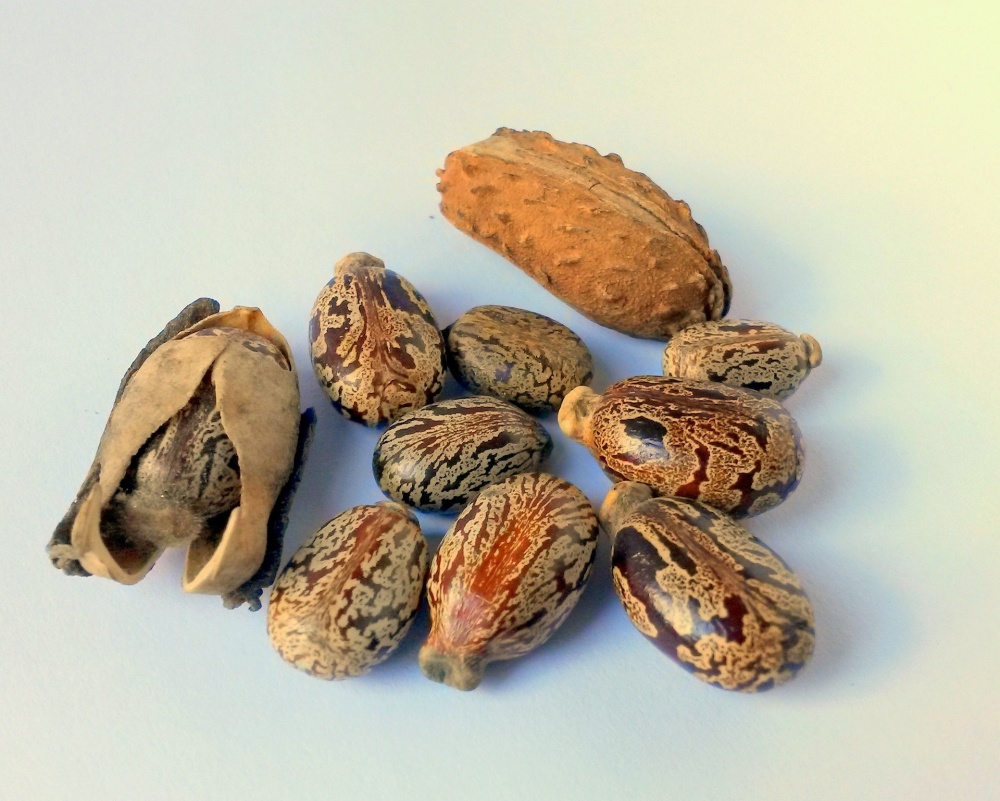
Seed
Material uses
Non-drying oil - The seed yields a cold-pressed, colourless to pale yellow, viscid oil known as 'Castor oil' or 'Palma Christi oil'. During hot pressing, the oil is brown to near-black. Ricin, a highly toxic protein poisonous to humans and animals, is present in the seed but is not carried over into the pressed oil. Oil yields range from 35 to 60% of seed weight.
Non-drying oils are oils that do not react with atmospheric oxygen on exposure to air and therefore do not form a solid film. Many non-drying oils are edible and used in food, while others serve as lubricants or as raw materials for soap making
Natural lubricant - Castor oil maintains a constant viscosity at high temperatures, making it a suitable lubricant, hydraulic fluid, and brake fluid for machinery and moving parts operating under a range of temperature and pressure conditions.
Biofuel - It has also reportedly been successfully engine-tested as a biodiesel.
Bio-based plastic - Castor oil is commercially processed into Polyamide 11, also known as Nylon 11, a thermoplastic in the nylon family of polymers used in high-pressure hoses (particularly in the oil and gas industry), automotive tubing, electrical cables, textiles, footwear, and metal coatings for noise reduction and corrosion protection.
The oil also has plasticising properties, meaning that when combined with other materials, it increases their flexibility and reduces brittleness. It is used in plastics to make them more malleable or mouldable, and in resins to make surface coatings ranging from paint and varnish to nail polish.
Natural carrier base - Also used as the base ingredient in lipstick, valued for its ability to dissolve pigments and provide a glossy finish; more than half of all lipstick sold in the United States contains castor oil.
Natural skin care - Also found in face and peeling masks, shaving cream, bath oils, and nail polish removers.
Hair tonic - Also used in hair-grooming products.
Natural soap - Soap made with castor oil has increased lathering power, is highly soluble in cold water, and is valued for making clear, transparent soaps.
Livestock feed - The leftover seedcake, after the oil is expressed, can be fed to livestock, but only after heat-treating it to destroy the ricin it contains.
Environmental uses
Green manure - The leftover seedcake after extracting the oil contains about 5% nitrogen, 2% phosphate, and 1% potash, and is mostly used to fertilise crops.
Edible uses
Natural edible coating - In confectionery, castor oil is used as an anti-sticking coating and release agent for hard candy, and in pharmaceuticals as a protective coating for pills.
Health uses
In India, castor oil is prescribed for nervous disorders. It is well known for its strong laxative and purgative action, particularly for treating food poisoning and for evacuating the bowel before an X-ray examination.
Climate
Castorbean flowers are highly susceptible to fungal disease brought on by humid conditions. For this reason, cultivation for seed production is best restricted to areas with a distinct dry season.
Grows naturally and is most productive in sub-humid to moderately humid subtropical and tropical climates, generally frost-free areas with annual lows of 14 to 26°C, annual highs of 26 to 36°C, annual rainfall of 700 to 2000 mm and a dry season of 3 to 7 months.
Castorbean also grows well with irrigation in areas with low rainfall and a long dry season. In fact, it is cultivated with irrigation in the Indian states of Gujarat and Rajasthan, in areas receiving only 300 mm annual rainfall and with a dry season lasting up to 9 months.
Growing
New plants usually start from seed, which germinates readily. Performance is best on friable, free-draining loam and sand soils of a moderately acid to alkaline nature, generally with a pH of 5 to 8 and on sites with full to partial sun exposure.
Sowing is in the rainy season and is timed so that flowering occurs at the start of the dry season, thereby minimising the risk of fungal attack.
Castorbean takes from four to seven months to mature after sowing. The seed capsules are harvested when they become yellowish, when they are ripe but not fully mature. They are then left in shallow piles in the sun to dry, which takes about four to five days.
Problem features
The seeds contain ricin, a poison that is highly toxic to humans and livestock.
Castorbean trees bear seed profusely, and these are scattered when the seed capsule bursts open. It is recorded as an invasive species in more than one country. The Hawaii Pacific Weed Risk Assessment project (HPWRA) and the IFAS Assessment of Non-Native Plants in Florida's Natural Areas assess it as a high weed-risk species for Hawaii and South Florida, respectively.
Pollen from male flowers can cause hay fever in some people.
Where it grows
References
Books
-
Adams, C. D. 1972, Flowering plants of Jamaica, University of the West Indies, Mona, Greater Kingston
-
Brady, G. S. & Clauser, H. R & Vaccari, J. A. 2002, Materials handbook : an encyclopedia for managers, technical professionals, purchasing and production managers, technicians and supervisors, 15th ed., McGraw-Hill, New York
-
Chevallier, A. 2000, Encyclopedia of herbal medicine, 2nd American ed., Dorling Kindersley, New York
-
Duke, J. A. 1983, Handbook of energy crops (unpublished), Center for New Crops & Plants Products, Purdue University, West Lafayette, Indiana
-
Editors of Sunset Magazine 2012, The New Western Garden Book: The Ultimate Gardening Guide, 9th edition, Sunset Publishing Corporation, California
-
Fawcett, W. 1891, Economic plants, An index to economic products of the vegetable kingdom in Jamaica, Jamaica Government Printing Establishment, Kingston
-
Francis, J. K. 2004, Wildland shrubs of the United States and its territories: Thamnic descriptions, U.S. Department of Agriculture, Forest Service, International Institute of Tropical Forestry, Río Piedras, San Juan, Puerto Rico & Rocky Mountain Research Station, Fort Collins, Colorodo
-
Gohl, B. 1981, Tropical Feeds : feed information summaries and nutritive values (Revised edition), Food and Agriculture Organization of the United Nations (FAO), Rome
-
Gunstone, F. D. 2011, Vegetable oils in food technology : composition, properties and uses, 2nd ed, Wiley-Blackwell, Hoboken, New Jersey
-
Jelks, Mary 1986, Allergy plants : that cause sneezing and wheezing, 1st ed., World-Wide Publications, Tampa, Florida
-
Khan, I. A. & Abourashed, E. A. 2010, Leung's encyclopedia of common natural ingredients : used in food, drugs and cosmetics, 3rd edition, Wiley Publishing, Hoboken, New Jersey
-
Litzenberger, S. C. 1974, Guide for field crops in the tropics and the subtropics, Office of Agriculture, Technical Assistance Bureau, Agency for International Development (USAID), Washington D.C.
-
Macmillan, H. F. 1943, Tropical planting and gardening : with special reference to Ceylon, 5th ed, Macmillan Publishing, London
-
McIlroy, R.J. 1963, An introduction to tropical cash crops, Ibadan University Press, Ibadan, Nigeria
-
Mors, W. B & Rizzini, C. T. 1966, Useful plants of Brazil, Holden-Day Publishing, San Francisco, California
-
Morton, J. F. 1971, Exotic plants, Golden Press, New York
-
Oakman, H. 1995, Harry Oakman's what flowers when : the complete guide to flowering times in tropical and subtropical gardens, University of Queensland Press, St. Lucia, Queensland
-
Parrotta, J. A. 2001, Healing plants of peninsular India, CABI Publishing, Wallingford, Oxfordshire
-
Perry, F. & Hay, R. 1982, A field guide to tropical and subtropical plants, Van Nostrand Reinhold Company, New York
-
Selvam, V. 2007, Trees and shrubs of the Maldives, Food and Agriculture Organisation (FAO) RAP publication (Maldives), Thammada Press Company Ltd., Bangkok
-
Smith, F. G. 2003, Beekeeping in the tropics, Northern Bee Books, Hebden Bridge, West Yorkshire
-
van der Vossen, H.A.M. & Mkamilo, G.S. (Editors) 2007, Plant Resources of Tropical Africa, Volume 14 : Vegetable oils, PROTA Foundation, Backhuys Publishers, Leiden
-
Winter, R. 2009, A consumer's dictionary of cosmetic ingredients : complete information about the harmful and desirable ingredients found in cosmetics and cosmeceuticals, 7th ed, Three Rivers Press, New York
Articles, Journals, Reports and Working Papers
-
Buddenhagen C.E., Chimera C. & Clifford P. 2009, Assessing Biofuel Crop Invasiveness: A Case Study, PLoS ONE 4
-
Johnson, A. & Johnson, S. 2006, Garden plants poisonous to people, New South Wales Department of Primary Industries (NSW DPI), Orange, New South Wales
-
Morton, J.F. 1964, Honeybee Plants of South Florida, Proceedings of the Florida State Horticultural Society, Vol 77:415-436.
-
Queensland Department of Agriculture and Fisheries (Australia) 1990, Weed and pest animal fact sheets, Brisbane