

Common name: Burmese Rosewood
Other common names: Amboyna Wood, Andaman Redwood, Burma Coast Padank, Indian Padauk, Malay Padauk, Narra, Papua New Guinea Rosewood, Philippine Mahogany, Red Narra, Weeping Rosewood, Yellow Narra
Description
Burmese Rosewood is a timber and landscape tree from Southeast Asia, with its natural range extending from southern China and the islands of southern Japan, south to the Philippines and Papua New Guinea.
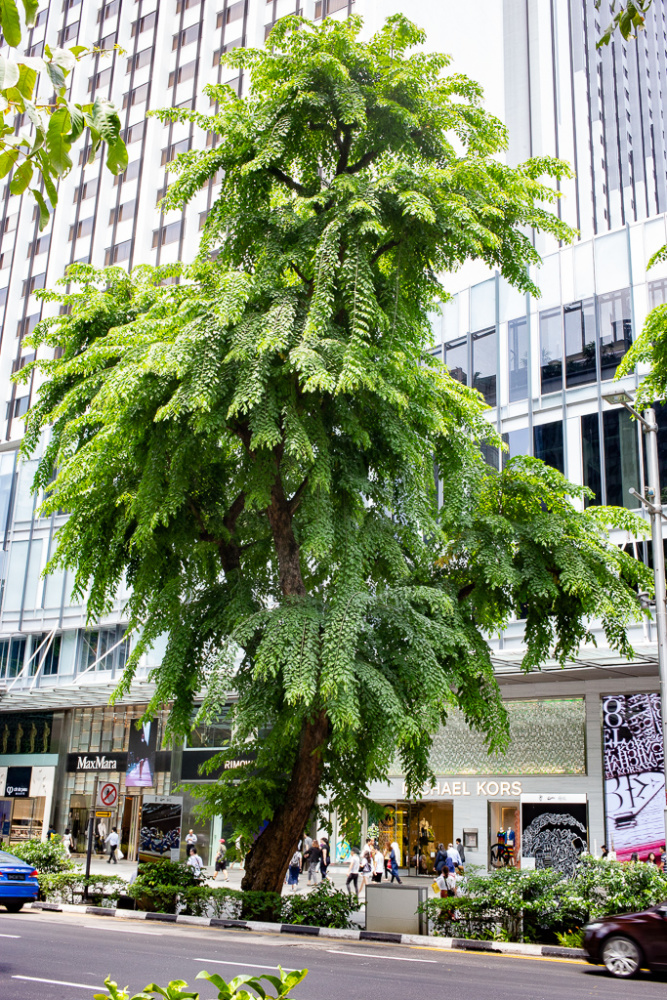
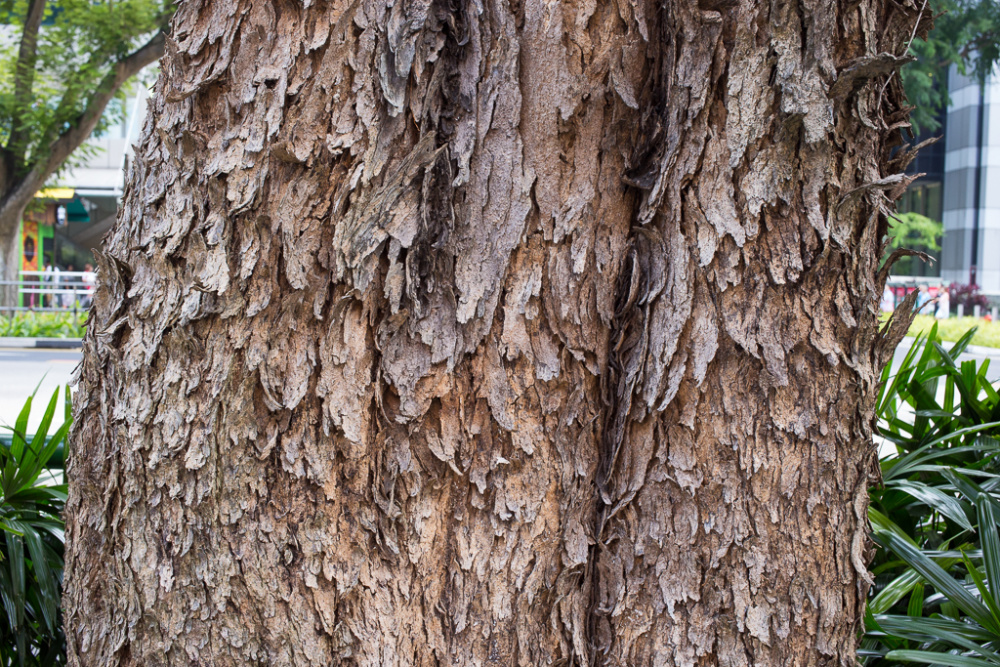
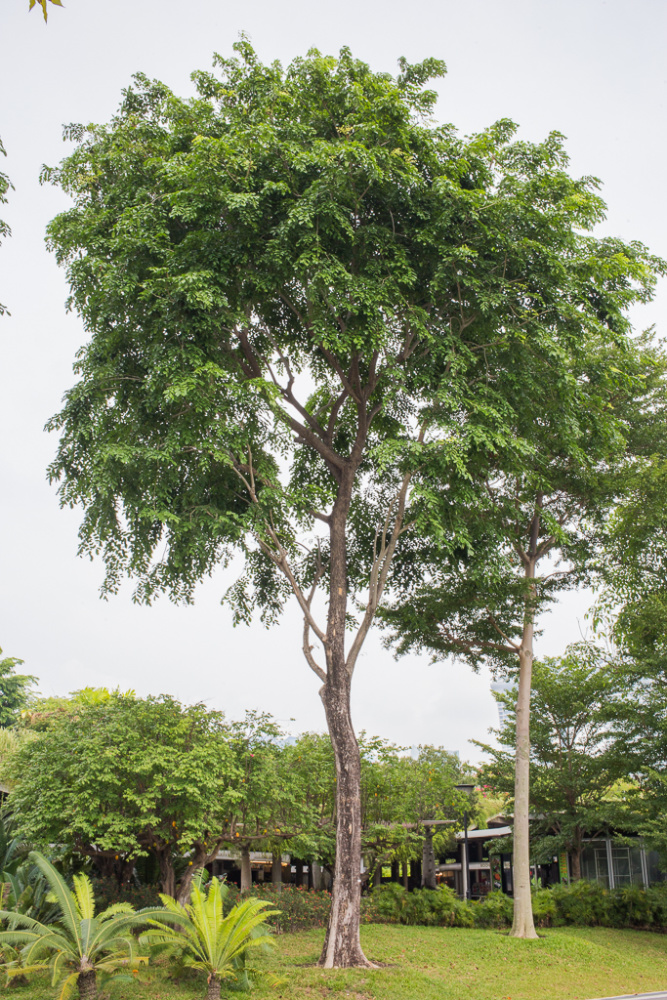
It is a tall tree in forest environments, reaching up to 40 m (130 ft) in height with a long, slender trunk up to 2 m (6.6 ft) in diameter. On open sites, it is typically 15 to 20 m (50 to 65 ft) tall, with a stout trunk, usually buttressed and fluted in large trees, and a wide-spreading crown. The branches droop, in some cases to near ground level, giving it a weeping appearance. The bark is grey-brown and fissured, becoming flaking with age.
Leaves are large and feathery, comprised of up to eleven glossy green ovate leaflets arranged alternately along the length and with an extra leaflet at the tip. In areas with a pronounced dry season, the leaves fall to conserve water, or they may remain on the tree where humid conditions prevail year-round.
Burmese Rosewood bears vanilla-scented, orange-yellow flowers in clusters that bloom from the start to the end of the dry season, coinciding with the seasonal replacement of old leaves with new ones.
Flat disc-shaped seedpods follow, with thin, wavy margins and a bulging middle enclosing one or two seeds in each of four seed chambers. Green and leathery when young, they become light brown and papery when mature.
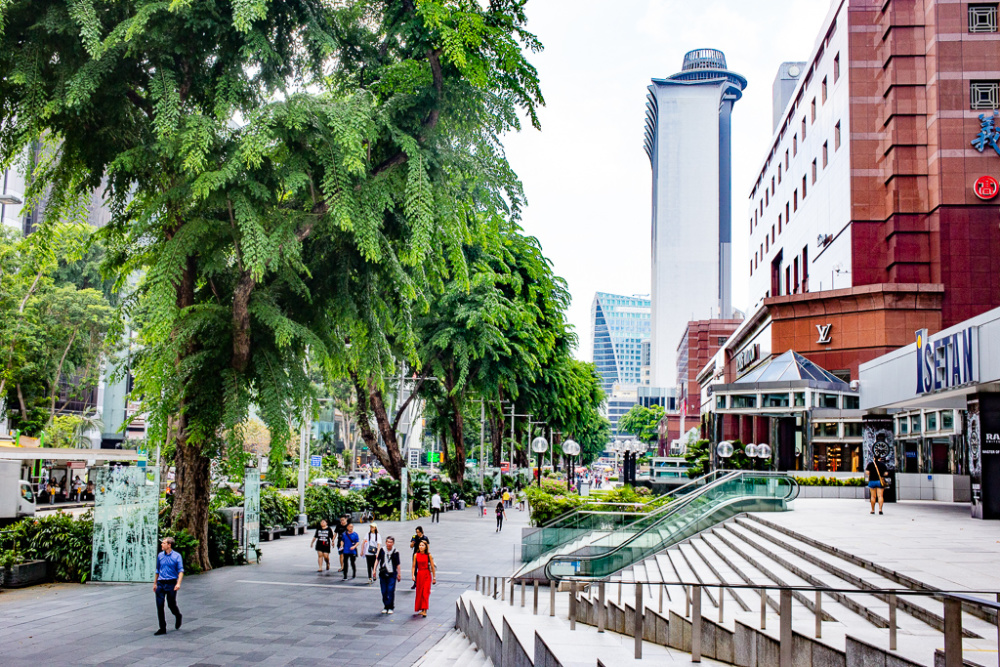
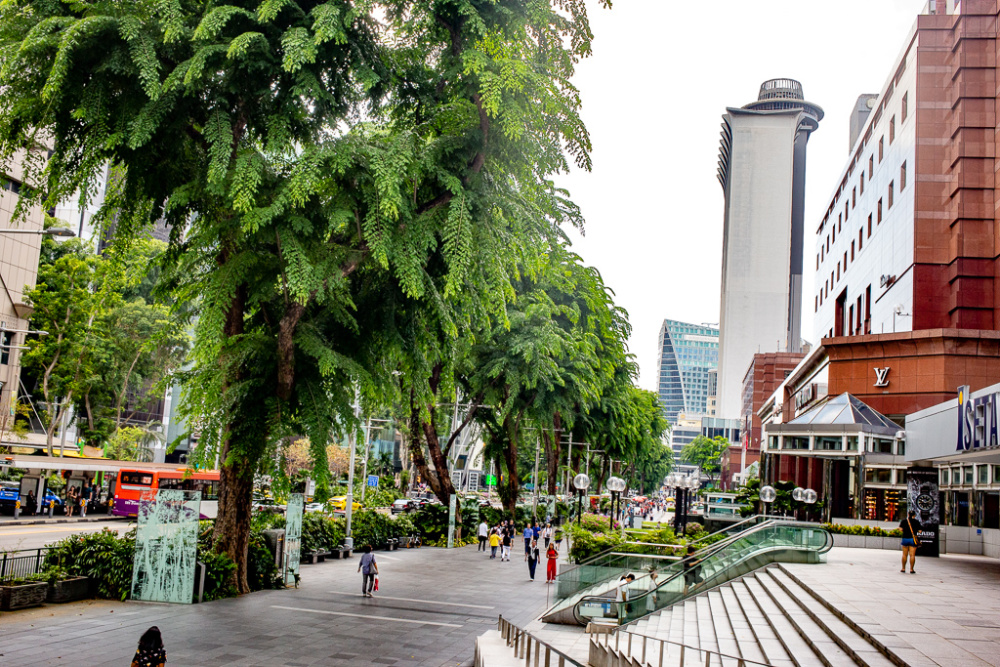
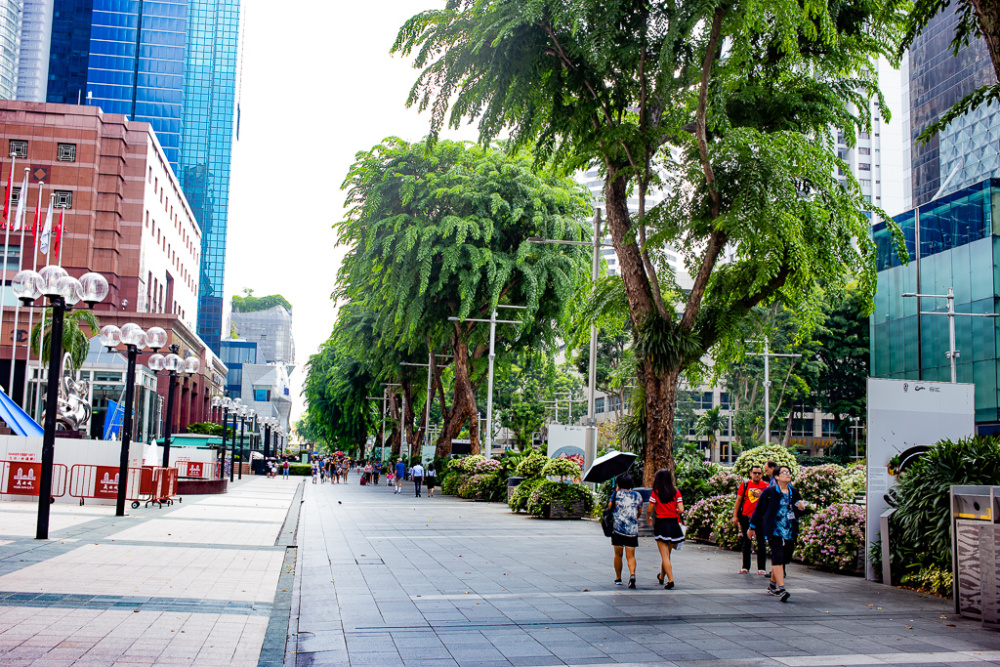
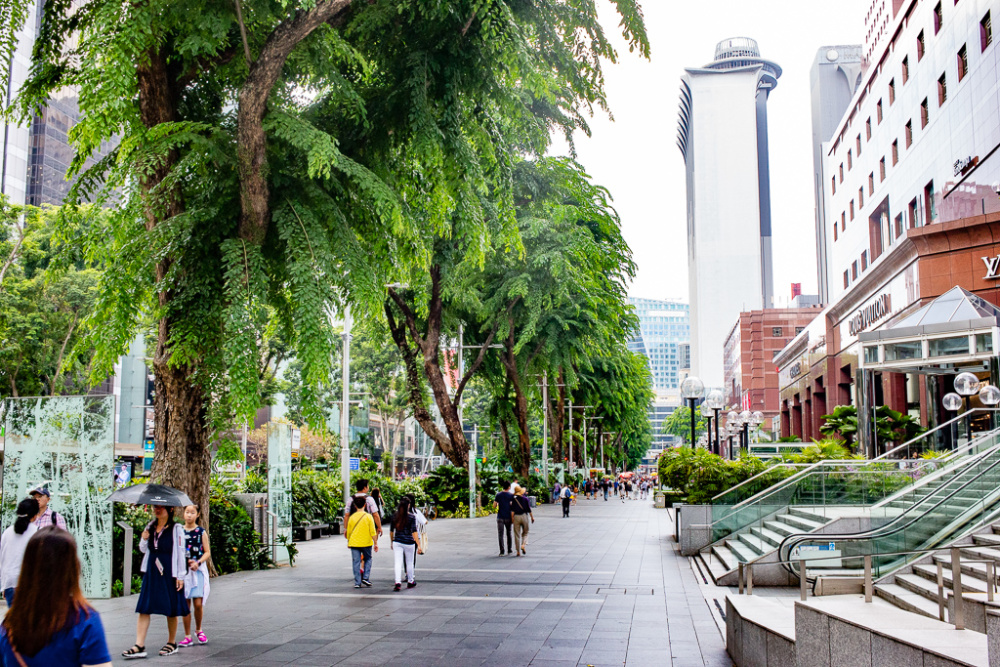
Orchard Road, Singapore
Material uses
Hardwood - The wood is medium-weight, ranging from 520 to 660 kilograms per cubic meter (32 to 41 lbs per cubic ft),
Decay- and rot-resistant wood -... has high natural resistance to rot and decay,
Termite-resistant wood - ...as well as high natural resistance to termites, making it a durable hardwood suitable for indoor and outdoor construction.
Timber and lumber - Well-formed logs are sawn into timber and lumber. The heartwood is resinous, fragrant, and comes in varying shades, from pale or golden yellow to dark red, depending on the tree's growth rate and age. It also has low shrinkage,
Furniture and cabinets -...and is used primarily for making fine furniture and cabinets. Large free-form planks are sometimes available and are reserved for making single-slab tabletops.
Flooring and decking - It is also commonly used for flooring,
Musical instruments - ...and for making musical instruments.
Decorative veneer - Selected logs are sliced for decorative veneer,
Manufactured wood - ...as well as for plywood.
Natural dye - The bark and wood also yield a dye, giving a reddish, yellowish, or brick-red colour, though less intense than that of the related, better-known Sanderswood (Pterocarpus santalinus).
Natural shampoo - In its native range, an infusion of the leaves is used as a shampoo.
Environmental uses
Street tree - One of the most commonly planted street trees in Singapore, it is cultivated as an ornamental and street tree,
Foliage ornamental - ...for its shapely form and handsome, weeping foliage,
Shade tree - ...and the shade it provides.
Bee forage - Honeybees actively work the flowers, but little information exists on its usefulness as a honey plant.
Species conservation - Habitat loss and over-exploitation of natural stands for its wood have led the IUCN to declare it a vulnerable tree species. This highlights its conservation needs.
Health uses
When wounded, the bark yields small amounts of dark red gum used in traditional medicine as a topical treatment for sores.
Climate
Grows naturally and has its best development in moderately humid to humid tropical lowland climates, generally frost-free areas with annual lows of 18 to 25°C, annual highs of 26 to 35 °C, annual rainfall of 1400 to 4500 mm and a dry season of 6 months or less.
Growing
New plants are easy to start from cuttings or seed, and cuttings remain viable for several years when stored in cold, dry, airtight conditions. Newly propagated plants need shade for about nine to twelve months before being planted out. Trees grown from cuttings start to flower two to three years earlier than seed-grown trees.
This leguminous tree converts atmospheric nitrogen into usable nitrogen in the soil, enabling it to grow on nutrient-poor soils through its roots. However, it performs best on deep, fertile, free-draining clay, loam and sand soils of an acid to neutral nature, generally with a pH of 5.0 to 7.5, and on sites with full to partial sun exposure. It tolerates drought, seasonal flooding, and strong winds.
Problem features
Burmese Rosewood is recorded as naturalised in Australia and Puerto Rico. Still, it does not appear to be recorded as a serious weed anywhere globally, despite its widespread distribution outside its native range, including introductions in countries across tropical America, the Caribbean, and Africa. The Hawaii Pacific Weed Risk Assessment (HPWRA) project assesses it as a low-to-medium weed-risk species for Hawaii.
It develops an extensive, shallow root system that may damage or lift pavements, footpaths or sidewalks if planted too close to these structures.
Where it grows
References
Books
-
Allen, O. N. & Allen, E. K. 1981, The Leguminosae : a source book of characteristics, uses, and nodulation, University of Wisconsin Press, Madison, Wisconsin
-
Barwick, M., et al. 2004, Tropical & subtropical trees : a worldwide encyclopaedic guide, Thames and Hudson, London
-
Boulger, G. S. 1889. The uses of plants : A manual of economic botany with special reference to vegetable products introduced during the last fifty years, Roper & Drowley, London
-
Chudnoff, M. 1984, Tropical timbers of the world, Forest Service, U.S. Department of Agriculture (USDA), Washington, D.C.
-
Dean, J. 2010, Wild Color : the complete guide to making and using natural dyes (Revised and updated edition), Watson-Guptill Publishing, New York
-
Elevitch, C. R. 2006, Traditional trees of Pacific Islands: their culture, environment and use, 1st edition, Permanent Agriculture Resources, Holualoa, Hawaii
-
Francis, J. K. 1998, Tree species for planting in forest, rural, and urban areas of Puerto Rico, U.S. Department of Agriculture, Forest Service, International Institute of Tropical Forestry, Río Piedras, Puerto Rico
-
Francis, J. K. and Liogier, H. A. 1991, Naturalized exotic tree species in Puerto Rico, General technical report SO-82, USDA Forest Service, Southern Forest Experiment Station, New Orleans
-
Genders, R. 1978, Scented flora of the world, Robert Hale Publishing, London & St. Martin's Press, New York
-
Jensen, M. 1999, Trees commonly cultivated in Southeast Asia : an illustrated field guide, 2nd ed., Food and Agricultural Organisation of the United Nations (FAO) Regional Office for Asia and the Pacific (RAP), Bangkok
-
Jim, C.Y. 1990, Trees in Hong Kong: Species for Landscape Planting, Hong Kong University Press, Hong Kong
-
Kraemer, J. H. 1945, Native woods for construction purposes in the South China Sea region, Bureau of Yards and Docks, United States Navy Department, Washington D.C.
-
Little, E. L. et al. 1964 and 1974, Common trees of Puerto Rico and the Virgin Islands (2 volumes), Forest Service, U.S. Department of Agriculture (USDA), Washington D.C.
-
Macmillan, H. F. 1943, Tropical planting and gardening : with special reference to Ceylon, 5th ed, Macmillan Publishing, London
-
Martin, F. W & Ruberte, R. M. 1975, Edible leaves of the tropics, U.S. Agency for International Development (USAID), and the Agricultural Research Service, U.S. Department of Agriculture (USDA), Mayaguez, Puerto Rico
-
National Research Council (Board on Science and Technology for International Development) 1979, Tropical legumes : resources for the future, The National Academies Press, Washington D. C.
-
Parrotta, J. A. 2001, Healing plants of peninsular India, CABI Publishing, Wallingford, Oxfordshire
-
Polunin, Ivan 1987, Plants and flowers of Singapore, Times Editions, Singapore
-
Porter, T. 2012, Wood : identification & use, Compact edition, Guild of Master Craftsman Publications, Lewes, East Sussex
-
Randall, R. P. 2002, A global compendium of weeds, R.G. and F.J. Richardson Press, Melbourne
-
Randall, R. P. 2007, The introduced flora of Australia and its weed status, Cooperative Research Centre for Australian Weed Management, Glen Osmond, South Australia
-
Reyes, G. 1992, Wood densities of tropical tree species, U.S. Department of Agriculture, Forest Service, Southern Forest Experiment Station, New Orleans, Louisiana
-
Scheffer, T. C & Morrell, J. J. 1998, Natural durability of wood : a worldwide checklist of species, Forest Research Laboratory, Oregon State University, Corvallis, Oregon
-
Selvam, V. 2007, Trees and shrubs of the Maldives, Food and Agriculture Organisation (FAO) RAP publication (Maldives), Thammada Press Company Ltd., Bangkok