

Common name: Rose Gum
Other common names: Flooded Gum, Saligna Gum
Description
Rose Gum is a large timber tree native to Australia, where it occurs in forest pockets on the continent's eastern fringe, extending from the subtropics to the tropics.
In natural forests, it often reaches over 40 m (130 ft), with exceptional specimens exceeding 60 m (197 ft), and it grows fast on favourable sites, averaging up to 2 m (6.5 ft) per year.
The trunk is usually straight and well-formed, branch-free for up to three-quarters of the tree's height, and supports a moderately branched, rounded crown. The bark peels, revealing smooth new bark in shades of white, pale grey, brown, and light green, depending on the stage of weathering.
As with most eucalypts, the leaves remain on the tree in all seasons and change shape as the plant matures. This species ranges from small, green, slim ovate leaves on seedling plants to narrowly lance-shaped leaves up to 20 cm (8 in) long on adult trees.
The flowers are typical of eucalypts, with long, creamy-white filaments arising from a cup-shaped base and are bisexual, with both male and female parts. They bloom from late summer to winter, with delayed blooms at high elevations, and are followed by small, woody, cone-shaped seedpods.
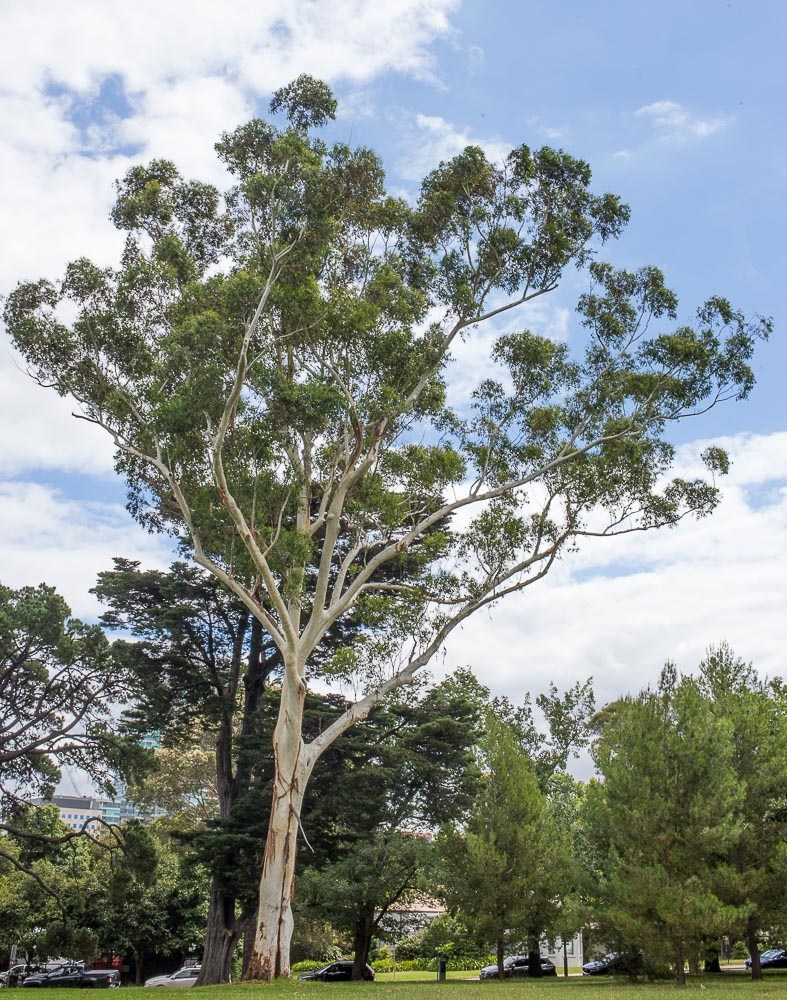
The Domain, Melbourne, Australia
Material uses
Hardwood - Rose Gum is a widely cultivated hardwood species, grown globally in many warm-climate regions, including plantations in Australia, India, Africa, and Brazil. Depending on maturity, the wood is light to medium weight, ranging from 480 to 600 kg per cubic metre (30 to 37 lb per cubic foot), and has moderate natural resistance to rot and decay.
Heavy construction - The sawn timber is used in heavy construction.
Light construction - ...as well as light construction, including house frames.
Joinery and millwork - ...also for interior joinery.
Furniture and cabinets - ... also for furniture and cabinets.
Boxes, crates and pallets - ...and for making boxes.
Decorative veneer - Also sliced for decorative veneer.
Poles and posts - Small-diameter roundwood is cut for posts and poles, such as fence posts and tall poles for carrying electricity and telecommunications cables.
Plant fibre pulp - It is also used to make paper pulp.
Firewood - ...as well as firewood.
Charcoal - ...and for making charcoal.
Mulch - In Florida, Rose Gum is cultivated to supply mulch wood for the landscaping and gardening trade.
Environmental uses
Bee forage - The flowers produce nectar and pollen for bee forage.
Edible uses
Honey - Rose Gum is classed as a major honey plant in South Africa, with honey yields averaging around 50 kg (110 lb) per colony per season; yields are much lower in Australia, where it is classed only as a minor honey plant. The honey itself is pale to medium amber, relatively thin, and has a strong, slightly unpleasant flavour. Honey properties vary significantly between low- and high-elevation areas - trees at high elevation reportedly produce a lighter-coloured, often better-flavoured honey, presumably because of fewer temperature extremes.
Climate
Grows naturally in humid subtropical and tropical climates, generally areas with annual lows of 9 to 20°C, annual highs of 19 to 32°C, annual rainfall of 700 to 3800 mm and a dry season of 7 months or less, extending to 12 months with irrigation or groundwater.
Growing
New plants are usually started from seed, which remain viable for several years if stored under cold, dry, airtight conditions. Rose Gum tolerates seasonal flooding and has a slight tolerance to soil salt. Growth appears unaffected on soils with salinity levels equivalent to up to 3 grams of salt per litre of water.
Performs best on free-draining acid to neutral sand, loam, and clay soils, generally with a pH of 5.5 to 7.0, and on sites with full to partial sun exposure.
Problem features
Seed production is prolific, and the seed germinates readily. It is recorded as having naturalised in New Zealand and as a weed in Southern Africa. The Hawaii Pacific Weed Risk Assessment (HPWRA) project and the IFAS Assessment of Non-Native Plants in Florida's Natural Areas assess it as a high weed risk species for Hawaii and Florida, respectively.
Rose Gum is not recommended for home gardens because it grows large and tends to drop branches in strong winds.
Where it grows
References
Books
-
Blake, S. T. & Roff, C. 1987, The honey flora of Queensland, 3rd ed., Queensland Department of Primary Industries (QLD DPI), Brisbane
-
Boland D.J., Brophy J.J. & House A. P. N. 1991, Eucalyptus leaf oils, use, chemistry, distillation and marketing, Australian Centre for International Agricultural Research (ACIAR) & Commonwealth Scientific Industrial Research(CSIRO), Inkata Press, Melbourne
-
Boland, D. & Brooker, I. & McDonald, M. W. 2006, Forest trees of Australia, 5th ed., CSIRO Publishing (Ensis), Melbourne
-
Burns R.M., Mosquera M.S. & Whitmone J.L. 1998, Useful trees of the tropical region of North America, North American Forestry Commission Publication (Number 3), Washington D.C.
-
Burns, R.M. & Honkala, B.H. 1990, Silvics of North America (Volume 2) : Hardwoods, Agricultural Handbook 654, U.S. Department of Agriculture (USDA), Washington D.C.
-
Clarke, B. & McLeod, I. & Vercoe, T. 2009, Trees for farm Forestry : 22 Promising Species, Rural Industries Research and Development Corporation (RIRDC), Wagga Wagga, New South Wales
-
Clemson, A. 1985, Honey and pollen flora, New South Wales Department of Agriculture, Inkata Press, Melbourne
-
Crane, E., Walker, P. & Day, R. 1984, Directory of important world honey sources, International Bee Research Association, London, United Kingdom
-
Francis, J. K. 1998, Tree species for planting in forest, rural, and urban areas of Puerto Rico, U.S. Department of Agriculture, Forest Service, International Institute of Tropical Forestry, Río Piedras, Puerto Rico
-
Holliday, I. 2002, A field guide to Australian trees, 3rd revised editon, New Holland Publishers, Frenchs Forest, New South Wales
-
Jensen, M. 1999, Trees commonly cultivated in Southeast Asia : an illustrated field guide, 2nd ed., Food and Agricultural Organisation of the United Nations (FAO) Regional Office for Asia and the Pacific (RAP), Bangkok
-
Lemmens, R.H.M.J., Louppe, D. & Oteng-Amoako, A.A. (eds). PROTA, Plant Resources of Tropical Africa, Volume 7(1) : Timbers 1, PROTA Foundation, Backhuys Publishers, Leiden
-
Liegel, L. H. 1987. A technical guide for forest nursery management in the Caribbean and Latin America, U.S. Dept. of Agriculture, Forest Service, Southern Forest Experiment Station, New Orleans
-
Luna, R. K 1996, Plantation trees, International Book Distributors, Dehradun, Uttarakhand
-
Marcar, N. E. 1995, Trees for saltland : a guide to selecting native species for Australia, Division of Forestry, Commonwealth Scientific and Industrial Research Organisation (CSIRO) Australia, Canberra
-
Menninger, E. A. 1967, Fantastic trees, Viking Press, New York
-
National Research Council (Board on Science and Technology for International Development) 1980, Firewood crops : shrub and tree species for energy production (Volume 1), The National Academies Press, Washington D. C.
-
Nicolle, D. (2016). Taller Eucalypts for Planting in Australia: Their Selection, Cultivation and Management. Dr Dean Nicolle, Adelaide.
-
Porter, T. 2012, Wood : identification & use, Compact edition, Guild of Master Craftsman Publications, Lewes, East Sussex
-
Randall, R. P. 2002, A global compendium of weeds, R.G. and F.J. Richardson Press, Melbourne
-
Randall, R. P. 2007, The introduced flora of Australia and its weed status, Cooperative Research Centre for Australian Weed Management, Glen Osmond, South Australia
-
Roecklein, J. C & Leung, P.S. 1987, A Profile of economic plants, Transaction Books, New Brunswick, New Jersey
-
Scheffer, T. C & Morrell, J. J. 1998, Natural durability of wood : a worldwide checklist of species, Forest Research Laboratory, Oregon State University, Corvallis, Oregon
-
Webb, D. B. 1984, A Guide to species selection for tropical and sub-tropical plantations, 2nd ed., Unit of Tropical Silviculture, Commonwealth Forestry Institute, University of Oxford, Oxfordshire