

Common name: Jamaica Cherry
Other common names: Panama Berry, Singapore Cherry, Strawberry Tree, Capulin
Description
Jamaica Cherry or Panama Berry is a landscape and fruiting tree native to tropical America, with its natural range extending from Mexico to Panama in Central America and from the Caribbean to northern parts of South America.
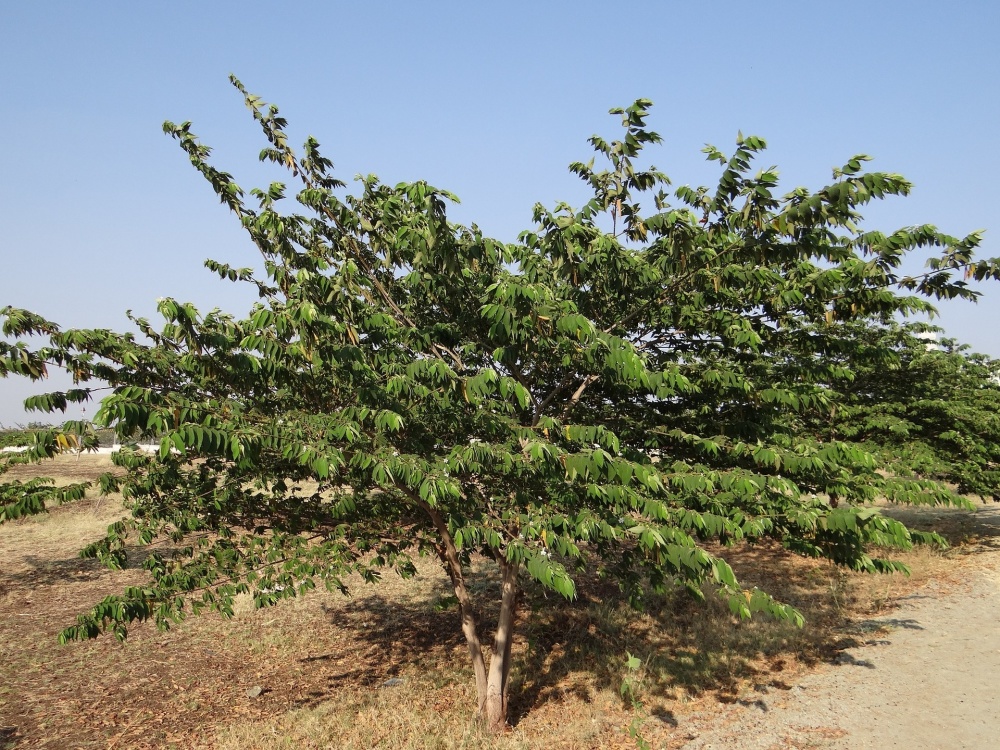
It is a fast-growing small to medium-sized tree that, on favourable sites, may reach up to 15 m (50 ft), though it is more typically 5 to 10 m (16 to 32 ft) tall.
The trunk is usually short, straight, and well-formed, supporting a wide-spreading crown of long, gently drooping branches. The bark is grey-brown or pale-brown and smooth, becoming cracked and rough on older trees.
The leaves are lance-shaped, 7 to 14 cm (3 to 6 in) long, medium green, and soft to the touch. They are evergreen in humid climates but semi-evergreen where the dry season is pronounced, with some leaf-fall occurring.
The flowers are small with white petals and a yellow centre, resembling strawberry flowers. They are normally in full bloom from spring to summer, with light blooms on and off at other times of the year, but are short-lived, lasting only a day.
The fertilised flowers are followed by round, berry-like fruit, 1.2 cm (0.5 in) in diameter, that are green when young, changing to yellow before ripening to bright red with thin skin, fleshy pulp and numerous tiny, round seeds.
Edible uses
Fresh fruit - Jamaica Cherry produces numerous small, edible fruits with a sweetish taste, mostly eaten fresh out of hand,
Fruit spread - ...but also made into jam.
Material uses
Firewood - The wood has low natural resistance to decay and is not normally used in construction. The branchwood is valued for firewood and is reported to ignite quickly and burn efficiently with little smoke when thoroughly dry.
Woven craft - The flexible bark has traditional use in Mexican woven craft, chiefly as a material for basketry.
Environmental uses
Foliage ornamental - The tree is occasionally cultivated in gardens for its shapely form and attractive foliage,
Shade tree - ...as well as the shade it provides.
Bee forage - Honeybees can be seen working the flowers, though no published information describes its importance to bee forage or honey production.
Climate
Jamaica Cherry grows and fruits naturally in sub-humid to moderately humid subtropical and tropical lowland to mid-elevation climates, generally areas with annual lows of 13 to 25°C, annual highs of 22 to 35°C, annual rainfall of 800 to 2300 mm and a dry season of 7 months or less.
Growing
New plants can be grown from cuttings or seed, with seedling trees starting to flower and fruit when just two to three years old. It performs well on a wide range of free-draining soils with an acid to neutral nature, generally with a pH of 5.5 to 7.0, and on sites with full to partial sun exposure.
Established trees should be pruned each year to encourage flowering and prevent the fast-growing branches from breaking off.
Problem features
Birds and bats eat the fruit and disperse the seed outside of cultivation. Once established, it can re-seed naturally, forming dense thickets. A free suckering habit contributes to its unwanted spread or escape. The Hawaii Pacific Weed Risk Assessment (HPWRA) project rates it as a high weed-risk species for Hawaii.
The ripe fruit fall from the tree and splatter on impact, creating a messy litter that stains surfaces.
Where it grows
References
Books
-
Adams, C. D. 1972, Flowering plants of Jamaica, University of the West Indies, Mona, Greater Kingston
-
Barwick, M., et al. 2004, Tropical & subtropical trees : a worldwide encyclopaedic guide, Thames and Hudson, London
-
Croat, T. B. 1978, Flora of Barro Colorado Island, Stanford University Press, Stanford, California
-
Francis, J. K. and Liogier, H. A. 1991, Naturalized exotic tree species in Puerto Rico, General technical report SO-82, USDA Forest Service, Southern Forest Experiment Station, New Orleans
-
Gargiullo, M. B & Magnuson, B. L. & Kimball, Larry D. 2008, A field guide to plants of Costa Rica, Oxford University Press, Oxford
-
Janick, J., & Paull, R. E. 2008, The encyclopedia of fruit & nuts, CABI Publishing, Wallingford, Oxfordshire
-
Jensen, M. 1999, Trees commonly cultivated in Southeast Asia : an illustrated field guide, 2nd ed., Food and Agricultural Organisation of the United Nations (FAO) Regional Office for Asia and the Pacific (RAP), Bangkok
-
Little, E. L. 1974, Trees of Puerto Rico and the Virgin Islands, Vol. 2, United States Department of Agriculture (USDA), Washington D.C.
-
Little, E.L. Jr. 1983, Common fuelwood crops: a handbook for their identification, McClain Printing Company, Parsons, West Virginia
-
Martin, F. M., et al. 1987, Perennial edible fruits of the tropics : an inventory, U.S. Dept. of Agriculture (USDA), Agricultural Research Service, U.S. Government Printing Office (GPO), Washington, D.C.
-
National Research Council (Board on Science and Technology for International Development) 1980, Firewood crops : shrub and tree species for energy production (Volume 1), The National Academies Press, Washington D. C.
-
Polunin, Ivan 1987, Plants and flowers of Singapore, Times Editions, Singapore
-
Randall, R. P. 2002, A global compendium of weeds, R.G. and F.J. Richardson Press, Melbourne
-
Randall, R. P. 2007, The introduced flora of Australia and its weed status, Cooperative Research Centre for Australian Weed Management, Glen Osmond, South Australia
-
Selvam, V. 2007, Trees and shrubs of the Maldives, Food and Agriculture Organisation (FAO) RAP publication (Maldives), Thammada Press Company Ltd., Bangkok
-
Vázquez, Y. C. 1999, Potentially valuable Mexican trees for ecological restoration and reforestation, Institute of Ecology, Database SNIB-REMIB-CONABIO, Project J084, Mexico
Articles, Journals, Reports and Working Papers
-
Morton, J. F. 1976, Pestiferous spread of many ornamental and fruit species in south Florida. In Proceedings of the Florida State Horticultural Society (Vol. 89, pp. 348-353).
-
Morton, J.F. 1964, Honeybee Plants of South Florida, Proceedings of the Florida State Horticultural Society, Vol 77:415-436.
-
Subhadrabandhu, S. 2001, Under-utilized tropical fruits of Thailand, Food and Agriculture Organisation of the United Nations (FAO), Regional Office for Asia and the Pacific (RAPA), Bangkok