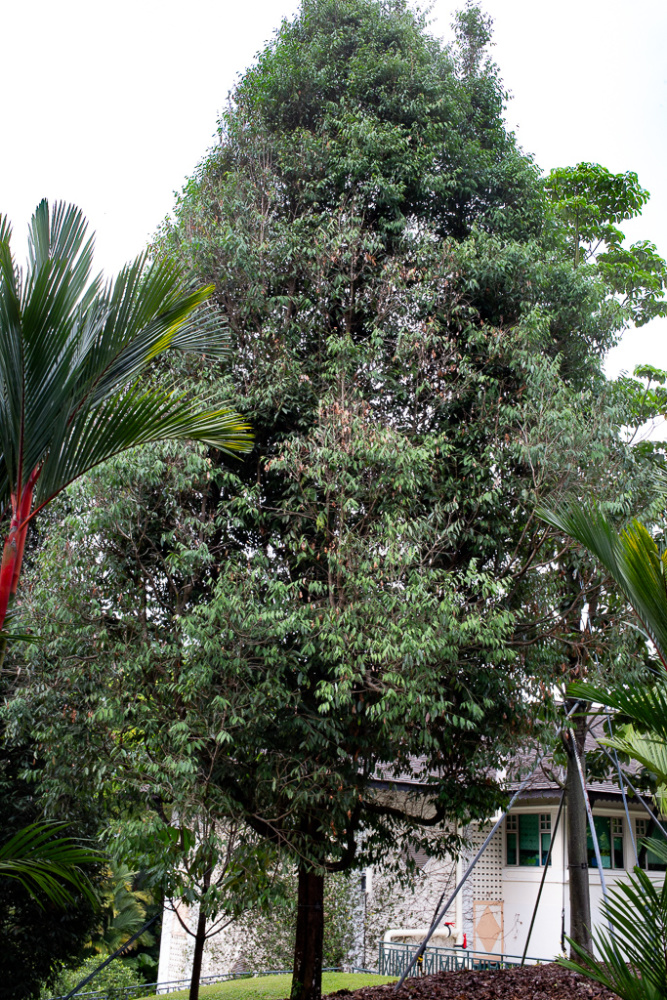


Common name: Ceylon Ironwood
Other common names: Indian Rose Chestnut, Ironwood Tree, Poached Egg Tree
Description
Mesua, or Ceylon Ironwood, is an ornamental timber tree native to south-west and north-east India, extending into Myanmar (Burma), Thailand, Malaysia, Vietnam, and Indonesia.
It is a slow-growing tree that can reach up to 30 m (98 ft) under favourable conditions, with a straight trunk and buttresses at the base of large trees, though it is more typically 10 to 20 m (30 to 60 ft) tall. In young trees, the crown is pyramidal-shaped, neat and low-branching. As the tree ages, the lower branches shed, and the crown becomes more rounded. The bark is grey and smooth on young trees, then peels as the tree ages.
Leaves are lance-shaped, 7 to 12 cm (3 to 5 in) long and remain on the tree throughout the year. When the new leaves emerge, they are a brilliant red, in spectacular flushes triggered by rising humidity. From a distance, they look like a tree in full bloom. As they age, their bright red colour fades to pink, then becomes dark, glossy green.
The flowers are four-petaled, 3 to 10 cm (1.2 to 4 in) wide, white with yellow centres and sweetly fragrant. They bloom from winter to spring, coinciding with the dry season in its native range, and are followed by small, egg-shaped, woody seed capsules with a pointed tip and one to four oily seeds inside.
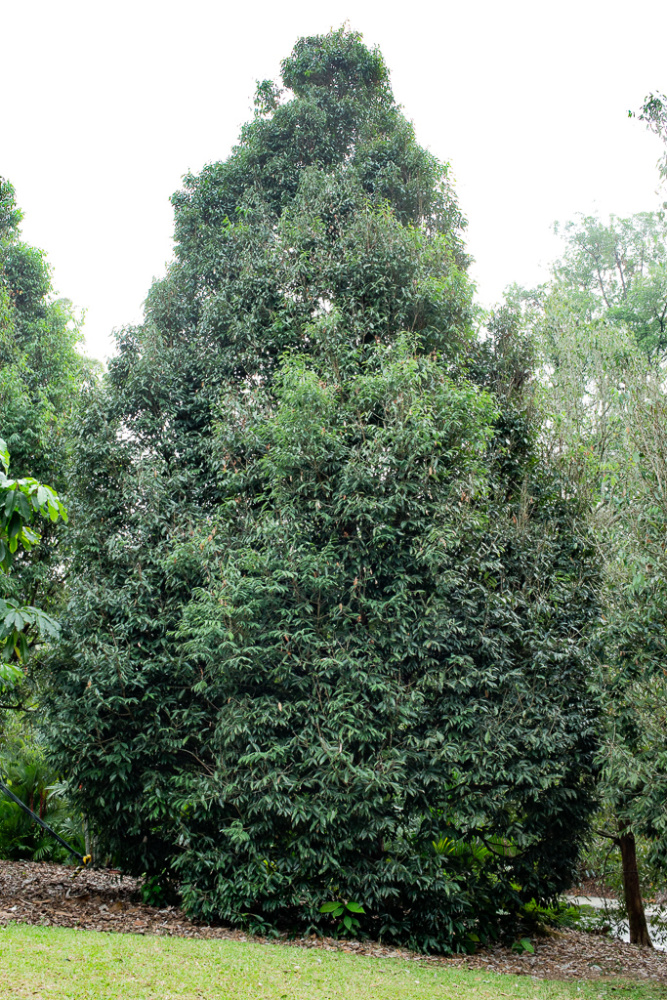
Young tree (Singapore Botanic Gardens)
Environmental uses
Foliage ornamental - It is an outstanding ornamental, with its neat, shapely form and brilliant red foliage,
Flowering ornamental - and large,
Fragrant plant - fragrant flowers.
Street tree - It is often planted as a street or avenue tree in its native range.
Material uses
Hardwood - Mesua produces a heavy reddish-brown wood, ranging from 800 to 900 kg per cubic meter (50 to 56 lbs per cubic ft),
Decay- and rot-resistant wood - ....with high natural resistance to rot and decay, making it suitable for indoor and outdoor construction.
Timber and lumber - Well-formed logs are sawn into beams and planks used in...
Boat building - ...boat building and, more broadly,
Heavy construction - ...heavy construction including bridge building,
Crossties or sleepers -... and for making crossties or sleepers for railway tracks.
Tool handles - The roundwood is shaped into tool handles.
Non-drying oil - Under cold mechanical pressing, the seed yields up to 70% dark brown, viscid oil. It has an unpleasant aroma that refining removes, and it is used to make
Natural soap - ...soap,
Natural lubricant - ....lubricants,
Biofuel - ...and long ago as an illuminant for lamps and lanterns.
Climate
Grows naturally in humid tropical lowland to mid-elevation climates, generally areas with annual lows of 18 to 24°C, annual highs of 27 to 33°C, annual rainfall of 1500 to 5500 mm and a dry season of 6 months or less. It develops best in areas with annual rainfall of 2000 mm or more.
Growing
New plants are started from seed or cuttings grown in a humid, misted environment. The seeds are extracted from fruit left out in the sun to split, then shade-dried. They only remain viable for a short time, needing to be sown soon after extraction from the fruit.
It performs best on free-draining clay and loam soils of a moderately acid to neutral nature, generally with a pH of 5.0 to 7.0, and on sites with full to partial sun exposure.
Problem features
No records appear to show it escaping cultivation and naturalising anywhere. The Hawaii Pacific Weed Risk Assessment (HPWRA) project assesses it as a low weed-risk species for Hawaii.
The resin exuded is reported to be toxic to humans if ingested.
Where it grows
References
Books
-
Barwick, M., et al. 2004, Tropical & subtropical trees : a worldwide encyclopaedic guide, Thames and Hudson, London
-
C.A.B. International 2013, The CABI encyclopedia of forest trees, CABI Publishing, Wallingford, Oxfordshire
-
Champion, H. G. & Seth, S. K. 1968, A revised survey of the forest types of India, Natraj Publishers, Dehradun, India
-
Chudnoff, M. 1984, Tropical timbers of the world, Forest Service, U.S. Department of Agriculture (USDA), Washington, D.C.
-
Dey, S.C. 1996, Fragrant flowers for homes and gardens, trade and industry, Abhinav Publications, New Delhi, India
-
Holttum, R. E. & Enoch, I. C. 2010, Gardening in the tropics : the definitive guide for gardeners, Marshall Cavendish Editions, Singapore
-
Krishen, P. 2006, Trees of Delhi : a field guide, Dorling Kindersley Publishers, Delhi
-
Letourneux, C. 1957, Tree planting practices in tropical Asia, Food and Agriculture Organization of the United Nations (FAO), Rome
-
Luna, R. K 1996, Plantation trees, International Book Distributors, Dehradun, Uttarakhand
-
Macmillan, H. F. 1943, Tropical planting and gardening : with special reference to Ceylon, 5th ed, Macmillan Publishing, London
-
Menninger, E. A. 1962, Flowering trees of the world for tropics and warm climates, 1st ed., Heathside Press, New York
-
Randall, R. P. 2007, The introduced flora of Australia and its weed status, Cooperative Research Centre for Australian Weed Management, Glen Osmond, South Australia
-
Scheffer, T. C & Morrell, J. J. 1998, Natural durability of wood : a worldwide checklist of species, Forest Research Laboratory, Oregon State University, Corvallis, Oregon
Articles, Journals, Reports and Working Papers
-
Singh, K. P. & Kushwaha, C. P. 2006, Diversity of flowering and fruiting phenology of trees in a tropical deciduous forest in India, Oxford University Press
-
Somashekhar, B. S. and M. Sharma. 2002. Training manual on propagation techniques of commercially important medicinal plants. Foundation for Revitalisation of Local Health Traditions, Bangalore, India.