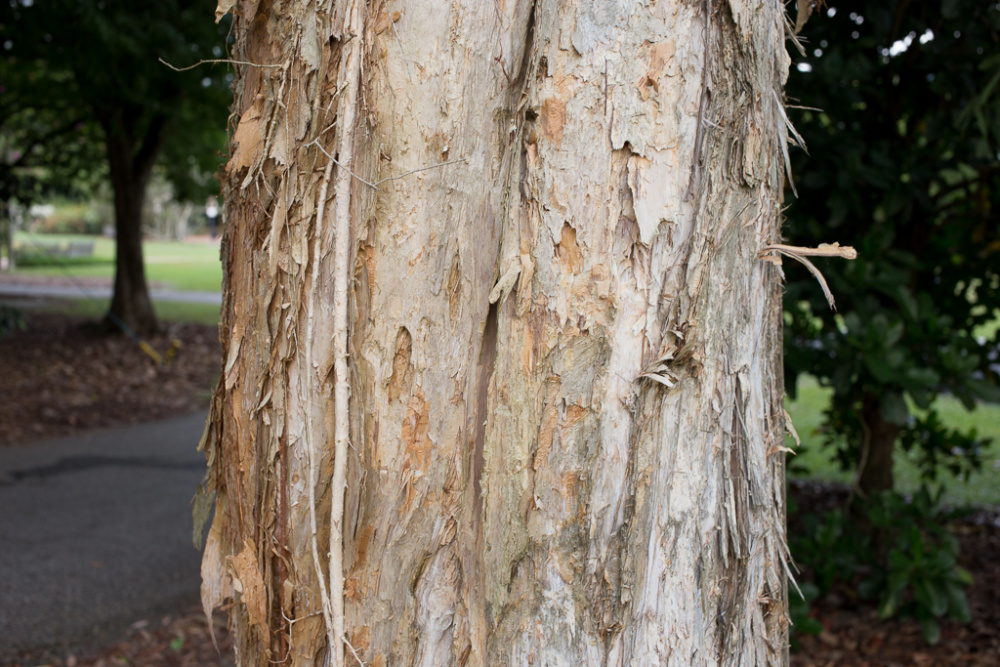


Common name: Cajaput
Other common names: Cajeput, Cajuput, Paperbark Tea Tree, Swamp Teatree
Description
Cajaput is an essential-oil-yielding tree native to Australia and Southeast Asia, with a natural range extending from northern Australia through Papua New Guinea to Indonesia, Singapore, Malaysia, Thailand, and Vietnam.
It may reach heights of up to 40 m (120 ft) with a trunk diameter of 1.2 m (4ft), though it is more typically a medium-sized tree 10 to 20 m (30 to 60 ft) tall. The trunk is stout and supports a heavily branched crown, pyramidal when young, becoming rounded with age. The bark is grey-white and peels into papery sheets that persist in layers on the trunk.
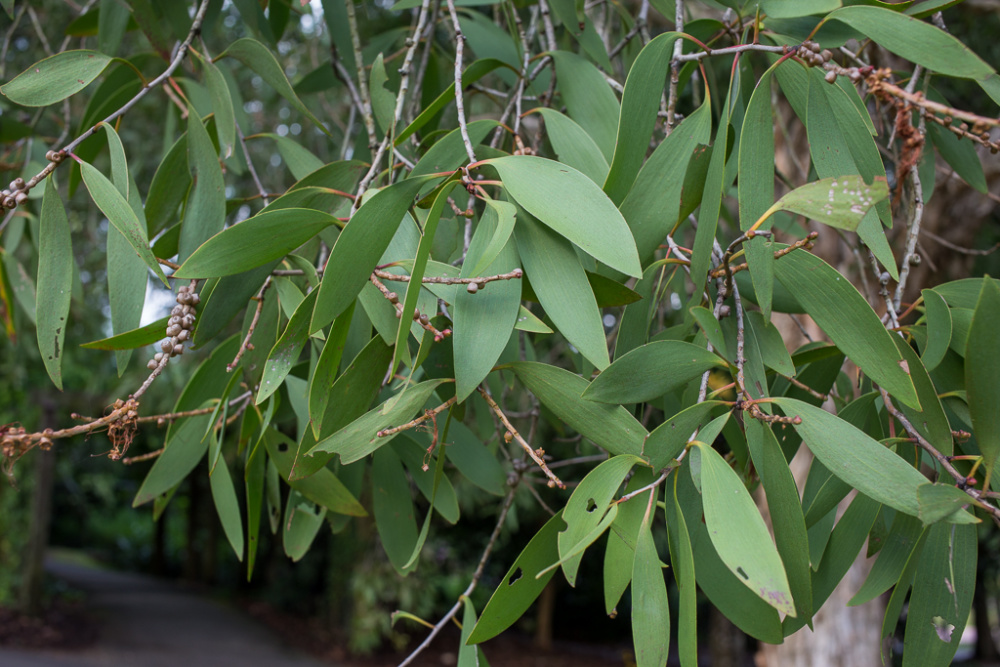
Leaves are elongated oval, up to 10 cm long, tapered at both ends, leathery, dull green and etched with longitudinal lines running from the tip to the stem end. They are alternately arranged along the stems at the ends of the branches and remain on the tree year-round.
The flowers have long white filaments and are in dense clusters resembling bottle brushes. These bloom on and off throughout the year, but are fullest in autumn, followed by small, woody, cup-shaped seed capsules up to 0.4 cm (0.2 in) in diameter that enclose many tiny seeds.
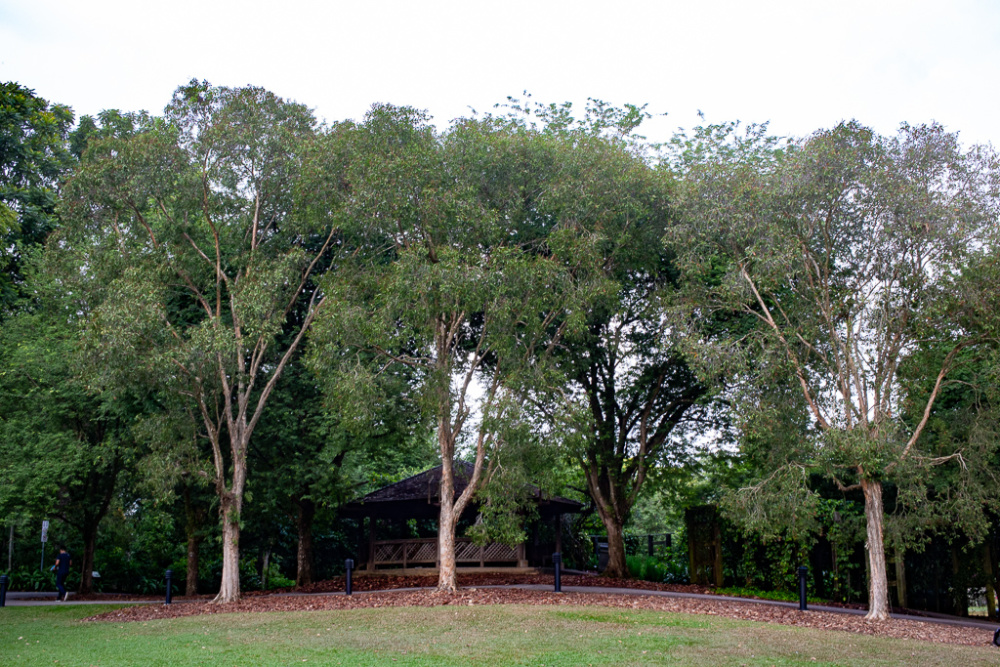
Singapore Botanic Gardens
Material uses
Essential oil - Steam distillation of the fresh leaves and young stems yields about 0.9 to 1% pale yellow essential oil, traded as 'Cajeput oil,' with a camphor-like odour similar to 'Niaouli oil' from Broadleaf Paperbark (Melaleuca quinquenervia). It is mostly composed of cineole (also known as eucalyptol, the principal compound found in eucalyptus oil, for example, from Eucalyptus globulus), which is strongly antiseptic and underpins the oil's extensive use in respiratory and oral-care remedies described in the Health uses below. The oil is produced commercially in Indonesia, Cambodia, and Vietnam, with combined annual production potentially exceeding 600 tonnes.
Natural deodorant - The oil is a common ingredient in everyday personal-care products, including deodorants, lip balms, acne treatments, sunscreens, and veterinary products.
Natural shampoo - It is also used in shampoos...
Natural fragrance - ...and its fragrance is valued in soaps, lotions, and perfumes.
Hardwood - The trunk yields a medium-weight wood (700 to 800 kg per cubic metre) with pale brown, fine-grained heartwood.
Decay- and rot-resistant wood - The wood has good natural resistance to rot and decay.
Marine-resistant wood - It is also durable in contact with both fresh and salt water.
Heavy construction - Well-formed logs, when available, are sawn into beams for bridge and wharf construction.
Flooring and decking - They are also sawn into planks for flooring...
Furniture and cabinets - ...also for making furniture and cabinets...
Boxes and crates - ...as well as boxes and crates.
Firewood - The wood makes an excellent firewood, and the soft, papery bark, which can be easily torn off the tree by hand, has long been used as kindling for starting fires.
Plant fibre pulp - The soft, papery bark shows promise as a source material for paper, fibreboard, packing material, and a cork substitute in insulation.
Edible uses
Natural flavouring - The oil is used in very small amounts as a flavouring in non-alcoholic beverages, confectionery, frozen desserts, baked goods, condiments, and relishes.
Environmental uses
Bee forage - Honeybees are observed actively working the flowers, though little information appears to exist on the tree's value to honey production.
Flowering ornamental - It is sometimes cultivated as a flowering ornamental.
Street tree - It is also planted as a street tree in parts of its native range.
Health uses
Natural dental care - Everyday products containing Cajeput oil include toothpaste, mouthwashes, gargles, throat lozenges, and dentistry and veterinary products.
Cajeput oil has long been used medicinally in its native range, taken internally to treat coughs and colds, and used externally to relieve pain. This mirrors its use in Western medicine as an antiseptic, mainly against colds, sore throat, respiratory infections, laryngitis, tracheitis, and bronchitis, often steam-inhaled like eucalyptus oil. It is also used against genitourinary infections and roundworms. Applied externally, it acts as a counterirritant, stimulating circulation, and, owing to its antispasmodic action, is used as a friction rub for rheumatic joints and neuralgia; it is also found as an active ingredient in ointments, gels, and liniments. Early investigations suggest the fruit may have antiviral properties, though this remains unconfirmed.
General interest
The name Cajaput comes from the Malayan 'Caju puti', meaning white tree, referring to the tree's grey-white bark.
Climate
Grows naturally in humid tropical lowland climates, generally in frost-free areas with annual lows of 19 to 25°C, annual highs of 29 to 35°C, annual rainfall of 900 to 4000 mm and a dry season of 5 months or less. It occurs on low, swampy coastal plains and in areas with seasonal flooding, as well as in hilly terrain on dry, rocky, infertile soils.
Growing
New plants are usually started from seed, and seedlings are tended in a nursery until the first flower buds form at around two years old, when they are planted out in the field. New plants are also started from stem and branch cuttings.
Performs best on free- to slow-draining clay-loam, loam, sandy-loam and loamy-sand soils of an acid to neutral nature, generally with a pH of 4.5 to 7.0 and on sites with full to partial sun exposure. It tolerates seasonal flooding, waterlogged soils, soil salinity, and strong winds. Varieties coming from eastern Indonesia are reportedly adapted to growing in hilly inland areas on infertile, gravelly soil.
In commercial operations, harvesting starts at four years after transplanting and is usually mechanical, stripping the leaves and stems and cutting the plant back to about 1 m (3 ft) tall. Harvesting is then repeated yearly for about five years, after which replanting occurs. Fresh-leaf harvests average 7,500 kgs per hectare per year, and steam distillation yields about 65 kgs of oil, the equivalent of 58 lbs per acre.
Problem features
Seed that falls to the ground is easily dispersed by flowing water and germinates readily. It can form dense stands, particularly in swampy areas or low-lying land subject to seasonal flooding.
The essential oil is poisonous if ingested in large amounts and should only be taken internally under medical supervision.
Where it grows
References
Books
-
Arctander, S. 1960, Perfume and flavor materials of natural origin, Elizabeth, New Jersey
-
Brady, G. S. & Clauser, H. R & Vaccari, J. A. 2002, Materials handbook : an encyclopedia for managers, technical professionals, purchasing and production managers, technicians and supervisors, 15th ed., McGraw-Hill, New York
-
Brophy, J. J., Craven, L. A. & Doran, J. C. 2013, Melaleucas: their botany, essential oils and uses, Australian Centre for International Agricultural Research (ACIAR), Canberra
-
C.A.B. International 2013, The CABI encyclopedia of forest trees, CABI Publishing, Wallingford, Oxfordshire
-
Chevallier, A. 2000, Encyclopedia of herbal medicine, 2nd American ed., Dorling Kindersley, New York
-
Cribb, A. B. & Cribb, J. W. 1982, Useful wild plants in Australia, William Collins, Sydney
-
Culbreth, D. M. R. 1927, A manual of materia medica and pharmacology : comprising the organic and inorganic drugs which are or have been recognized by the United States pharmacopeia, 7th ed., Febiger, Philadelphia
-
Do, D. S. & Nguyen, H. N. 2003, Use of indigenous tree species in reforestation in Vietnam, Agricultural Publishing House, Hanoi
-
Doran, J. C & Turnbull, J. W. 1997, Australian trees and shrubs : species for land rehabilitation and farm planting in the tropics, 2nd ed, Australian Centre for International Agricultural Research (ACIAR), Canberra, Australian Capital Territory
-
Groom, N. 1997, The new perfume handbook, 2nd ed., Blackie Academic & Professional, London
-
Jelks, Mary 1986, Allergy plants : that cause sneezing and wheezing, 1st ed., World-Wide Publications, Tampa, Florida
-
Khan, I. A. & Abourashed, E. A. 2010, Leung's encyclopedia of common natural ingredients : used in food, drugs and cosmetics, 3rd edition, Wiley Publishing, Hoboken, New Jersey
-
Macmillan, H. F. 1943, Tropical planting and gardening : with special reference to Ceylon, 5th ed, Macmillan Publishing, London
-
National Research Council (Board on Science and Technology for International Development) 1983, Firewood crops : shrub and tree species for energy production (Volume 2), The National Academies Press, Washington D. C.
-
Oyen, L. P. A. & Nguyen X. D. 1999, Plant Resources of South-East Asia (PROSEA) 19 : Essential-oil plants, Backhuys Publishers, Leiden
-
Randall, R. P. 2002, A global compendium of weeds, R.G. and F.J. Richardson Press, Melbourne
-
Streets, R. J. & Troup, R. S. 1962, Exotic forest trees in the British Commonwealth, Oxford University Press, Oxford, England
-
Weiss, E. A. 1997, Essential oil crops, CABI Publishing, Wallingford, Oxfordshire
-
Winter, R. 2009, A consumer's dictionary of cosmetic ingredients : complete information about the harmful and desirable ingredients found in cosmetics and cosmeceuticals, 7th ed, Three Rivers Press, New York