


Description
Macadamia is a nut-bearing tree originating in eastern Australia, in subtropical rainforests extending from coastal northern New South Wales to southeast Queensland.
Through cultivation, its range has expanded to other parts of the subtropics. Within Australia, it grows just south of the town of Mackay; outside Australia, it grows in countries such as Hawaii, where it is now a commercially important nut crop.
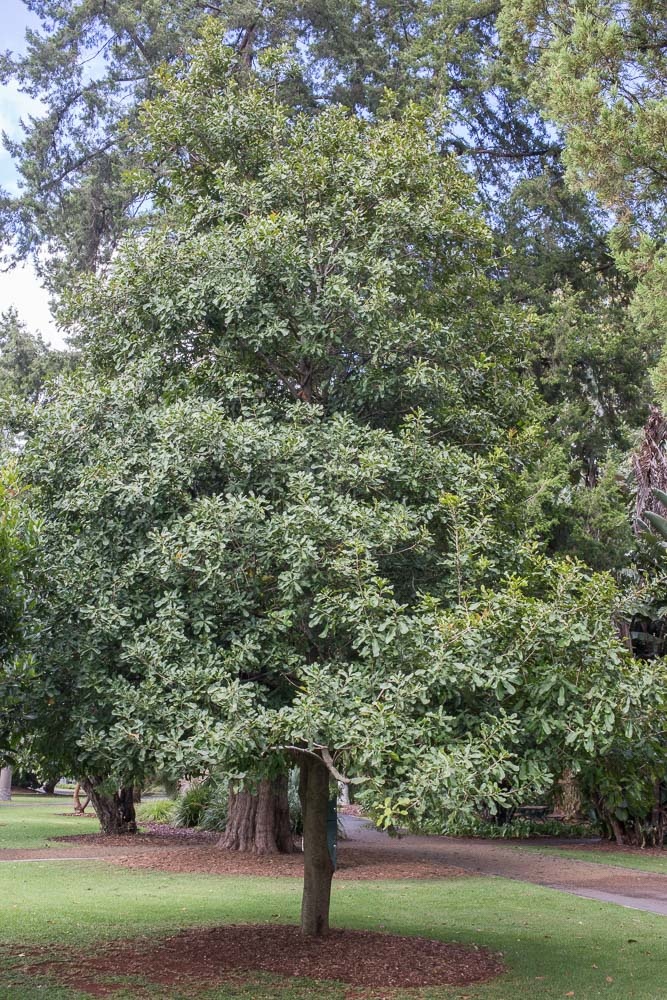
In natural forests, it may be a small tree up to 15 m (50 ft) tall with a straight trunk up to 30 cm (1 ft) in diameter. On open sites and in cultivation, it is typically 5 to 10 m (15 to 30 ft) tall, with a short, low-branching trunk and a densely leafy, pyramidal or rounded crown. The bark is brown, smooth on young trees, becoming slightly rough on older trees.
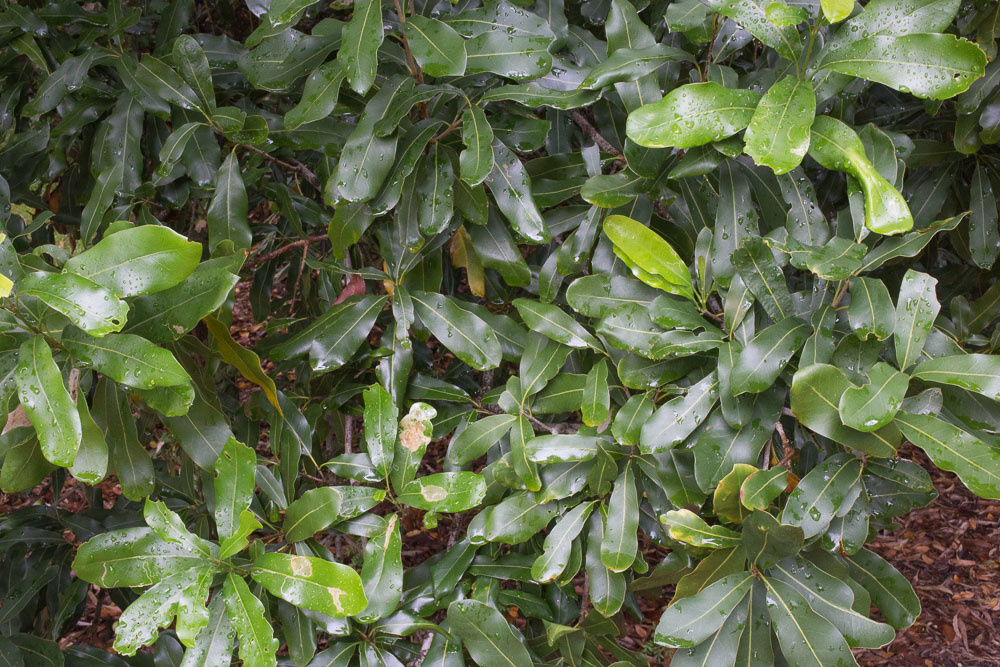
Leaves are club-shaped and leathery, 10 to 30 cm (4 to 12 in) long, bronze-red when they emerge and turning glossy green, with wavy margins that are sometimes toothed or prickly. They are spirally arranged towards the ends of the branches and remain on the tree throughout the year.
Flowers are small, creamy-white, petalless tubes borne in numbers of one to three hundred or more, in flower spikes 10 to 30 cm (4 to 12 in) long, resembling bottle brushes. They bloom in the dry season, from winter to spring in subtropical Australia, with spikes possibly numbering in the thousands hanging from the ends of the branches, almost completely hiding the green foliage from view.
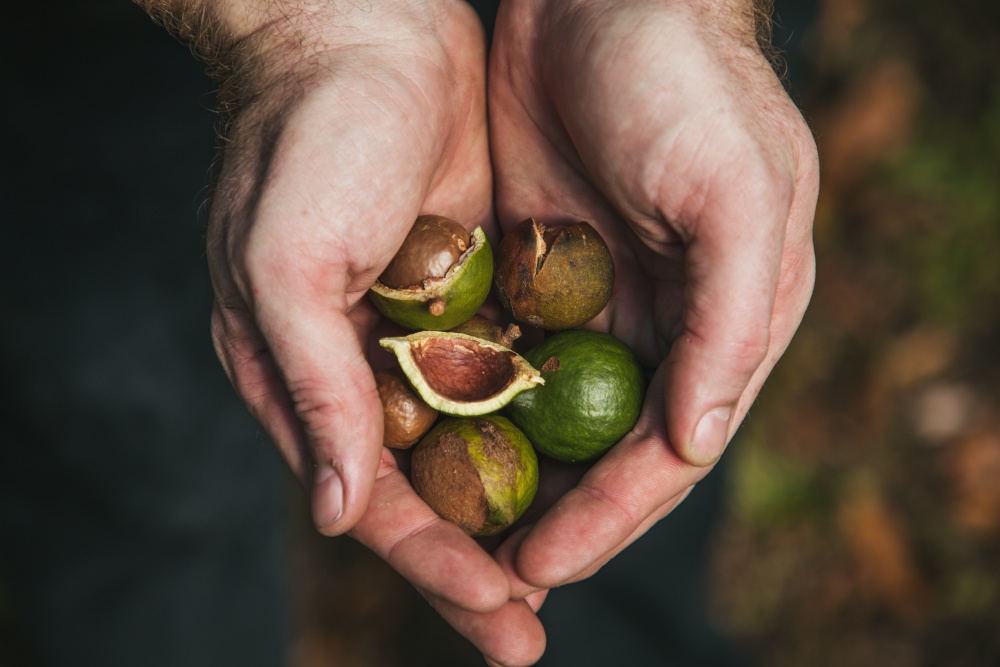
Although the flowers are perfect, having both female and male parts, only a few flowers on each spike develop into fruit. When mature, the fruit is roundish, with a prominent nipple and a smooth, green, leathery peel that somewhat resembles a young lime.
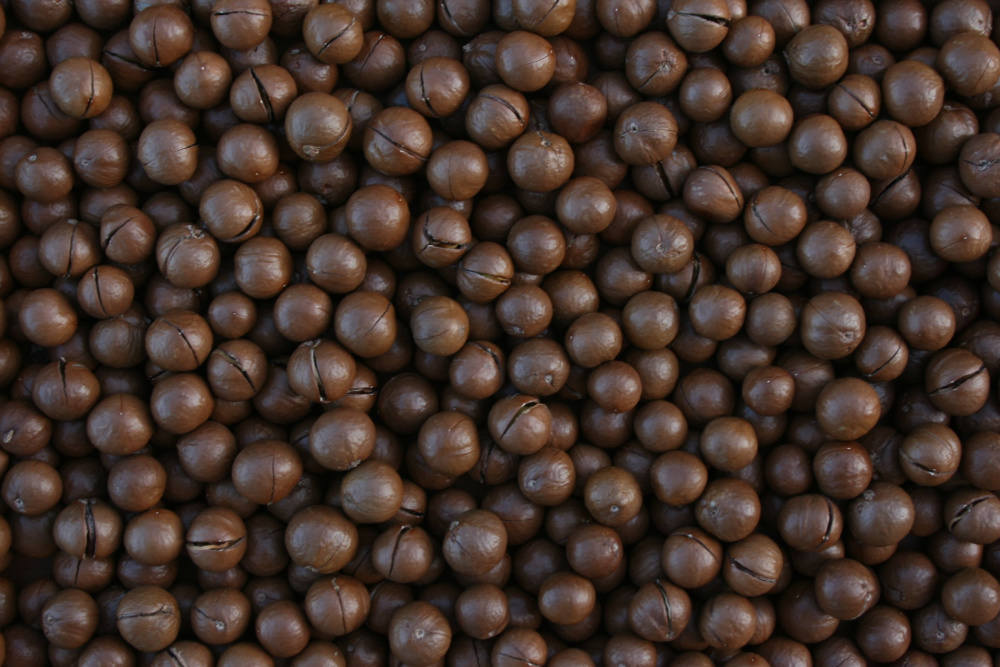
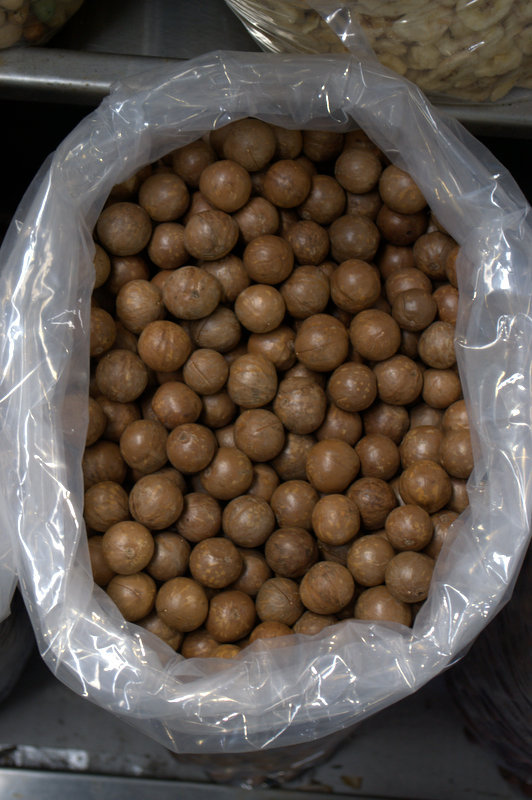
The peel surrounds a round nut with a glossy brown shell that is very hard and difficult to crack open. It protects an edible, round kernel with creamy, nutty, oily white flesh. As the fruit ripens, the peel splits, releasing the nut, which falls to the ground.
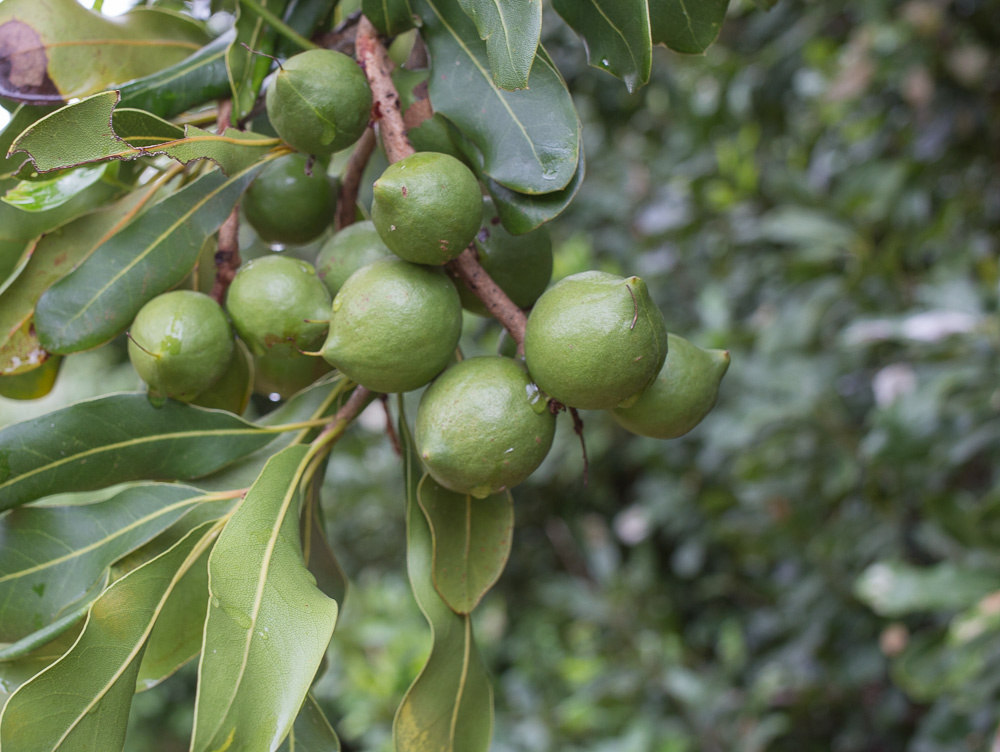
Fruit containing the nut
Edible uses
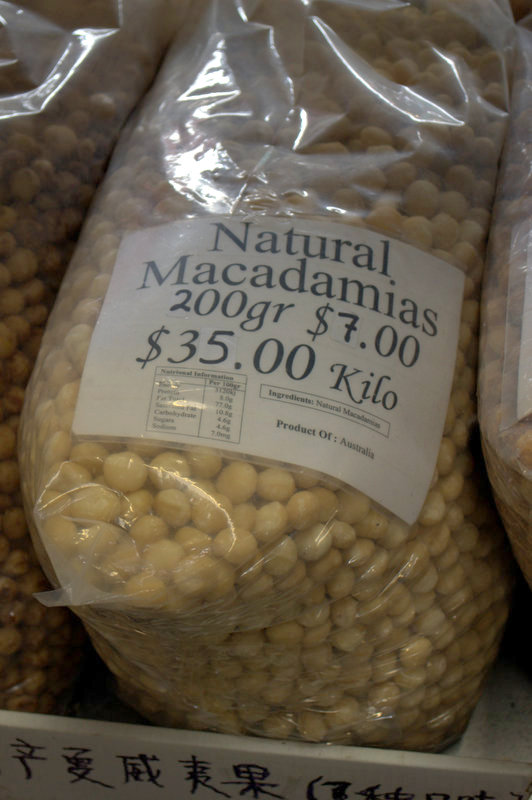
Edible nut - The fallen nuts are collected from the ground, stored, and left to dry for about a week before being eaten or processed. Macadamias are a popular nut, cultivated commercially and sold as-is raw, roasted, salted, or unsalted or used in snack foods and confectionery, such as chocolate-coated (Theobroma cacao), baked into cookies, or added to ice cream.
Edible oil - They also yield an edible oil, marketed as a high-end salad oil.
Plant-based milk - More recently, also used to make a milk substitute.
Honey - Pure Macadamia honey is light to medium amber, medium-density, and slow to granulate, with a rich, moderately sweet flavour reminiscent of butterscotch, malt, and caramel.
Environmental uses
Bee forage - The flowers produce enough nectar to make honey production economical, with yields of 25 to 50 kg (55 to 110 lb) per colony per season reported in Australia.
Climate
Macadamia grows naturally and is productive in humid subtropical and tropical mid-elevation climates, generally frost-free areas with annual lows of 11 to 19°C, annual highs of 20 to 32°C, annual rainfall of 800 to 3700 mm and a dry season of 5 months or less, extending to 8 months with irrigation or groundwater.
A more cold-hardy species of Macadamia, known as the Rough-Shelled Macadamia (Macadamia tetraphylla), has been successfully cultivated in cooler climates, such as the San Francisco Bay Area in California. Most Macadamia cultivated in California is a hybrid cross (Macadamia integrifolia × Macadamia tetraphylla)
Macadamia trees may fail to flower and fruit, or do so poorly, in areas where the average low temperature of the coldest month is above 16°C (61°F).
Growing
New plants are usually produced vegetatively, using cuttings and air-layering (circumposing) techniques. Although new plants are also started from seed, seedling trees show great variation in yield and nut characteristics. Vegetatively produced trees also come into bearing sooner, around two years earlier than seedling trees, when three to four years old.
Performs best on deep, rich, free-draining clay and loam soils of a moderately acid to neutral nature, generally with a pH of 5.0 to 7.0, and on sites with full to partial sun exposure. It has poor tolerance to slow-draining or saturated soils and strong winds.
Yields reported for Australia range from 12 to 15 kgs (26 to 33 lbs) of in-the-shell nuts per tree per year. However, yields in Hawaii are significantly higher.
Problem features
It is listed as a weed in at least one reference publication. Still, there appears to be no record of it as a serious weed, despite its widespread introduction and cultivation in the tropics. The Hawaii Pacific Weed Risk Assessment (HPWRA) project assesses it as a low weed-risk species for Hawaii.
The milky sap exuded by part of the plant is high in Hydrogen cyanide (HCN), also known as prussic acid. This poisonous compound should be treated with caution.
Where it grows
References
Books
-
Axtell, B. L & Fairman, R. M 1992, Minor oil crops, Food and Agriculture Organization of the United Nations (FAO), Rome
-
Barwick, M., et al. 2004, Tropical & subtropical trees : a worldwide encyclopaedic guide, Thames and Hudson, London
-
Doran, J. C & Turnbull, J. W. 1997, Australian trees and shrubs : species for land rehabilitation and farm planting in the tropics, 2nd ed, Australian Centre for International Agricultural Research (ACIAR), Canberra, Australian Capital Territory
-
Editors of Sunset Magazine 2012, The New Western Garden Book: The Ultimate Gardening Guide, 9th edition, Sunset Publishing Corporation, California
-
Elevitch, C. R. & Thaman, R. R. 2011, Specialty crops for Pacific islands, 1st ed, Permanent Agriculture Resources, Hawaii
-
Elevitch, C. R. 2006, Traditional trees of Pacific Islands: their culture, environment and use, 1st edition, Permanent Agriculture Resources, Holualoa, Hawaii
-
Fellows, P. 1997, Traditional foods : processing for profit, Intermediate Technology, Technical Centre for Agricultural and Rural Co-operation, London
-
Gunstone, F. D. 2011, Vegetable oils in food technology : composition, properties and uses, 2nd ed, Wiley-Blackwell, Hoboken, New Jersey
-
Holliday, I. 2002, A field guide to Australian trees, 3rd revised editon, New Holland Publishers, Frenchs Forest, New South Wales
-
Jensen, M. 1999, Trees commonly cultivated in Southeast Asia : an illustrated field guide, 2nd ed., Food and Agricultural Organisation of the United Nations (FAO) Regional Office for Asia and the Pacific (RAP), Bangkok
-
Jex-Blake, A. J. 1957, Gardening in East Africa : a practical handbook, 4th ed., Royal Kenya Horticultural Society, Longmans, Green and Company, London
-
Kennard, W. C. & Winters, H. F. 1960, Some fruits and nuts for the tropics, Miscellaneous Publication No. 801, U.S. Department of Agriculture, Federal Experimental Station, Mayaguez, Puerto Rico
-
Leech, M. 2013, Bee Friendly: A planting guide for European honeybees and Australian native pollinators, Rural Industries Research and Development Corporation (RIRDC), Canberra, Australian Capital Territory
-
Macmillan, H. F. 1943, Tropical planting and gardening : with special reference to Ceylon, 5th ed, Macmillan Publishing, London
-
Page, P. E. 1984, Tropical tree fruits for Australia, Queensland Department of Primary Industries (QLD DPI), Brisbane
-
Perkins, K. D. & Payne, W. 1981, Guide to the poisonous and irritant plants of Florida, Florida Cooperative Extension Service, Gainesville, Florida
-
Perry, B. 2010, Landscape plants for California gardens: an illustrated reference of plants for California landscapes, Land Design Publishing, Claremont, California
-
Randall, R. P. 2002, A global compendium of weeds, R.G. and F.J. Richardson Press, Melbourne
-
Rosengarten, F. 1984, The book of edible nuts, Walker and Company Publishing, New York
-
Tindall, H. D. & Rice, L. W. 1990, Fruit and vegetable production in warm climates, International ed., Macmillan, London
Articles, Journals, Reports and Working Papers
-
Morton, J.F. 1964, Honeybee Plants of South Florida, Proceedings of the Florida State Horticultural Society, Vol 77:415-436.
-
Watson, B.J., & Moncur, M. 1985, Guideline criteria for determining survival, commercial and best mean minimum July temperatures for various tropical fruit in Australia (Southern Hemisphere), Department of Primary Industries Queensland (DPI QLD), Wet Tropics Regional Publication, Queensland
-
Wenkam N.S. & Miller C.D. 1965, Composition of Hawaii fruits (Bulletin 135), University of Hawaii, Honolulu